YouTrip Family
YouTrip Family
A new generation of growth
A new generation of growth
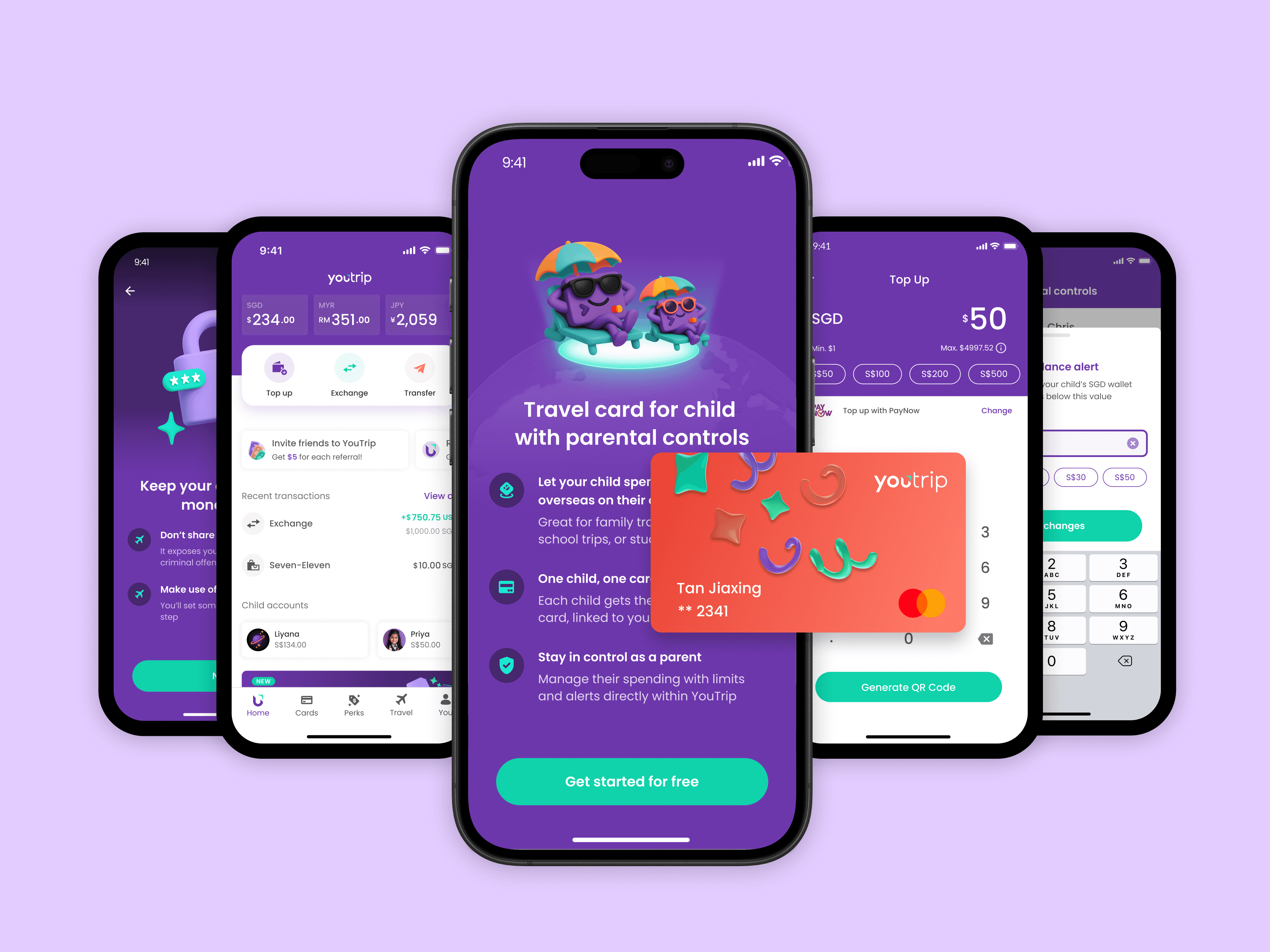
Company: YouTrip
Teammates: Sebastien Kun, Nicole Teng, Meem Nordin, Si Wei Puar, Vincent Ong
Company: YouTrip
Teammates: Sebastien Kun, Nicole Teng, Meem Nordin, Si Wei Puar, Vincent Ong
Duration: Q3-Q4 2025
Deliverables: Mobile app feature
Duration: Q3-Q4 2025
Deliverables: Mobile app feature
Background
Background
YouTrip operates as a leading multi-currency travel wallet, heavily utilized in markets like Singapore, Thailand, and Australia. By 2023, the platform had achieved an impressive milestone, with one in four Singapore residents using the service and driving S$10 billion in annual transaction volume. To unlock a new generation of growth, YouTrip identified families as a strategic expansion demographic. The business objectives were clear: lower customer acquisition costs, increase customer lifetime value, and drive a projected 60% growth in transaction volume by 2025. The overarching goal was to design a "0-1" product—YouTrip Family—that would capture 40,000 new child accounts by 2026 and generate an estimated $487 million in annual domestic B2C gross transaction value.
YouTrip operates as a leading multi-currency travel wallet, heavily utilized in markets like Singapore, Thailand, and Australia. By 2023, the platform had achieved an impressive milestone, with one in four Singapore residents using the service and driving S$10 billion in annual transaction volume. To unlock a new generation of growth, YouTrip identified families as a strategic expansion demographic. The business objectives were clear: lower customer acquisition costs, increase customer lifetime value, and drive a projected 60% growth in transaction volume by 2025. The overarching goal was to design a "0-1" product—YouTrip Family—that would capture 40,000 new child accounts by 2026 and generate an estimated $487 million in annual domestic B2C gross transaction value.
Problem
Problem
A competitive review revealed a significant gap in the market: existing financial products for children offered limited controls or lacked multi-currency, travel-first capabilities. To deeply understand user needs, the design team conducted 14 immersive UX research sessions during the June 2025 school holidays, observing how families managed children's finances.
The research uncovered competing desires between parents and children. Parents prioritized safety and oversight, demanding real-time transaction alerts, online purchase monitoring, and friction-free onboarding without tedious manual verifications. Conversely, children's needs scaled with their age: 7-10 year-olds relied heavily on parent support and physical cards; 11-14 year-olds demanded more decision-making power and smartphone access; and 15-18 year-olds expected full self-serve autonomy.
Strategy and Execution
Strategy and Execution
Transitioning from a traditional product-led framework to a collaborative, design-led approach, the team shaped the entire product requirements document (PRD) around these research insights.
Frictionless onboarding via Singpass: Instead of forcing parents through a tedious manual KYC (Know Your Customer) process involving ID scans and video verification, the team integrated Singpass. This allowed the app to securely auto-retrieve children's profiles from government records, enabling instant approval with zero manual KYC for the kids. The system even supported batch signups for multiple children simultaneously.
Overhauling information architecture (IA): To provide parents with immediate visibility, the post-login dashboard was entirely restructured. Rather than hiding child accounts deep in the settings, the new IA brought child cards and sub-accounts directly to the primary home navigation layer, ensuring parents could monitor balances and transfer funds without obstruction.
Tailored Child App Experience: The team designed a simplified companion app specifically for children. It allowed younger users to check their balances, track their spending, and request top-ups, while explicitly restricting complex features.
The "Graduation" Workflow: Recognizing that users outgrow child accounts, the team designed a transition workflow for when teenagers turn 15 and receive their first identity card. The app utilizes multi-year progressive prompts and milestone notifications to smoothly guide the user in converting to a full adult account, ensuring funds are safely transferred or returned to the parent if the upgrade isn't completed.
Outcomes
Outcomes
The beta launch of YouTrip Family proved highly successful. On day one, the platform immediately captured over 40 signups, and by June 2026, the activation campaign achieved 110% of its target—recording 5,000 activations against a goal of 3,500. Internally, the project revolutionized the company's workflows, proving the value of early immersive UX research and establishing a much tighter feedback loop between product, design, and leadership.
The beta launch of YouTrip Family proved highly successful. On day one, the platform immediately captured over 40 signups, and by June 2026, the activation campaign achieved 110% of its target—recording 5,000 activations against a goal of 3,500. Internally, the project revolutionized the company's workflows, proving the value of early immersive UX research and establishing a much tighter feedback loop between product, design, and leadership.