Tripadvisor Experiences
Tripadvisor Experiences
From Hard Sell to Helpful Guide
From Hard Sell to Helpful Guide
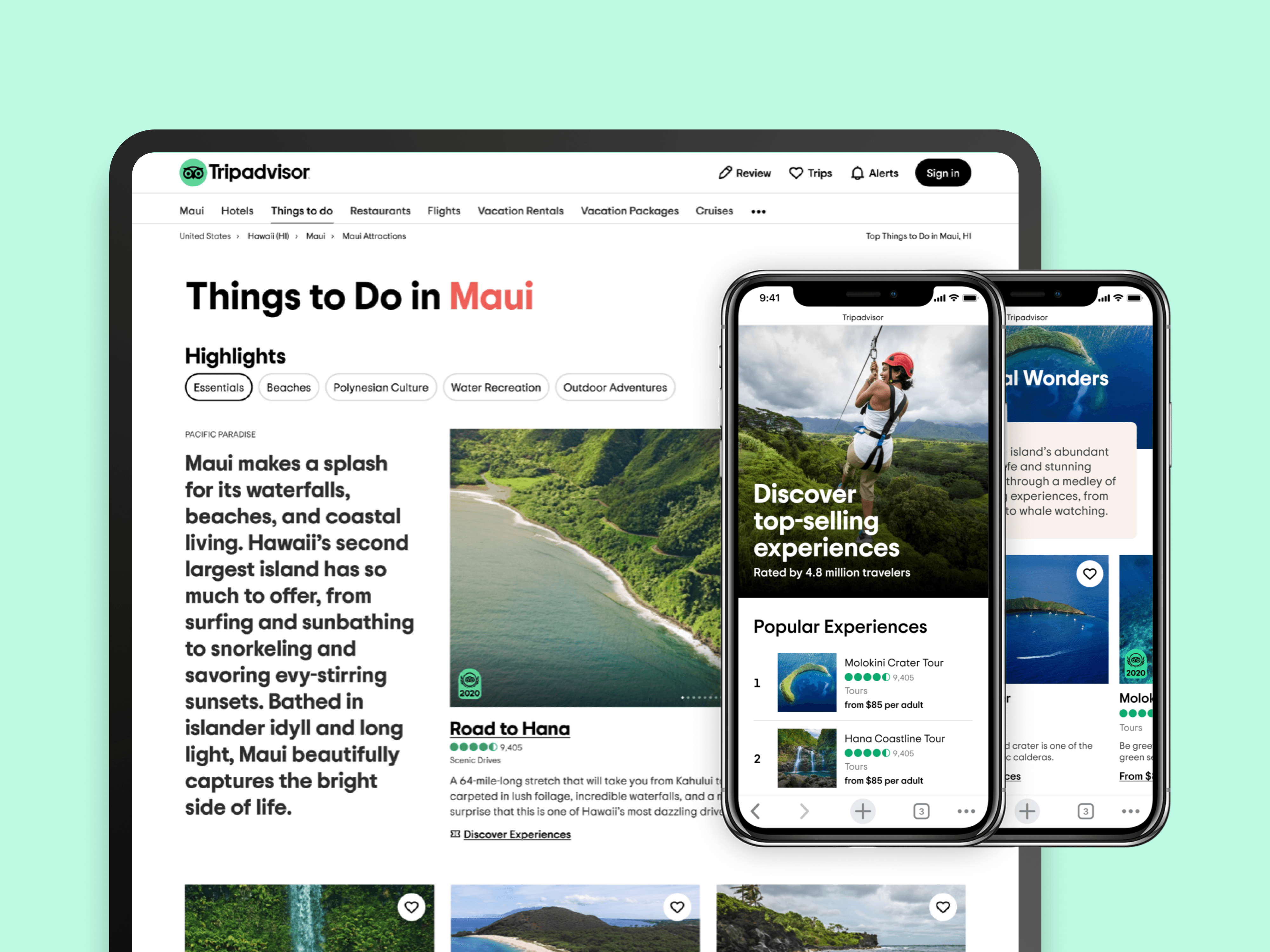
I led the redesign of Tripadvisor's $170M Experiences business to address high bounce rates and weak discovery. Our team transformed transactional pages into inspirational ones, which increased user engagement and strengthened funnel performance.
I led the redesign of Tripadvisor's $170M Experiences business to address high bounce rates and weak discovery. Our team transformed transactional pages into inspirational ones, which increased user engagement and strengthened funnel performance.
Company: Tripadvisor
Teammates: Alec Wong, Shahina Khanna, Jia En Koh, Emma Ryan
Company: Tripadvisor
Teammates: Alec Wong, Shahina Khanna, Jia En Koh, Emma Ryan
Duration: Q2-Q4 2021
Deliverables: Full-funnel redesigns for web and app, prototypes, UX research, competitive audits
Duration: Q2-Q4 2021
Deliverables: Full-funnel redesigns for web and app, prototypes, UX research, competitive audits
Background
Background
Tripadvisor is world-renowned guidance platform for travelers. The Things To Do segment guides travelers on tours and experience on-destination and facilitates bookings, and fast becoming the most profitable arm of the business.
Tripadvisor is world-renowned guidance platform for travelers. The Things To Do segment guides travelers on tours and experience on-destination and facilitates bookings, and fast becoming the most profitable arm of the business.
Tripadvisor has multiple business units, including Hotels, Things To Do, Restaurants, Flights and Vacation Rentals. Among all these, Hotels, Things To Do and Restaurants become the hallmark for the business because they bring in the most revenues.
Tripadvisor has multiple business units, including Hotels, Things To Do, Restaurants, Flights and Vacation Rentals. Among all these, Hotels, Things To Do and Restaurants become the hallmark for the business because they bring in the most revenues.
Problem
Problem
My team was assigned to improve Things To Do since 2021. Even when it was bringing significant revenue, we have a discovery problem. We bring in bookable products a bit too early in the funnel, and users bounced off the initial geo (destination) pages.
My team was assigned to improve Things To Do since 2021. Even when it was bringing significant revenue, we have a discovery problem. We bring in bookable products a bit too early in the funnel, and users bounced off the initial geo (destination) pages.
In 2021, the Things To Do (TTD) geo (destination) pages successfully attracted a substantial audience of 193 million visitors, predominantly through organic search results on Google. Despite this impressive traffic volume, a significant challenge emerged: approximately 85% of these visitors were in the research phase of their travel planning and not immediately prepared to make a booking. This disparity between visitation and conversion was reflected in a low conversion rate of only around 11%.
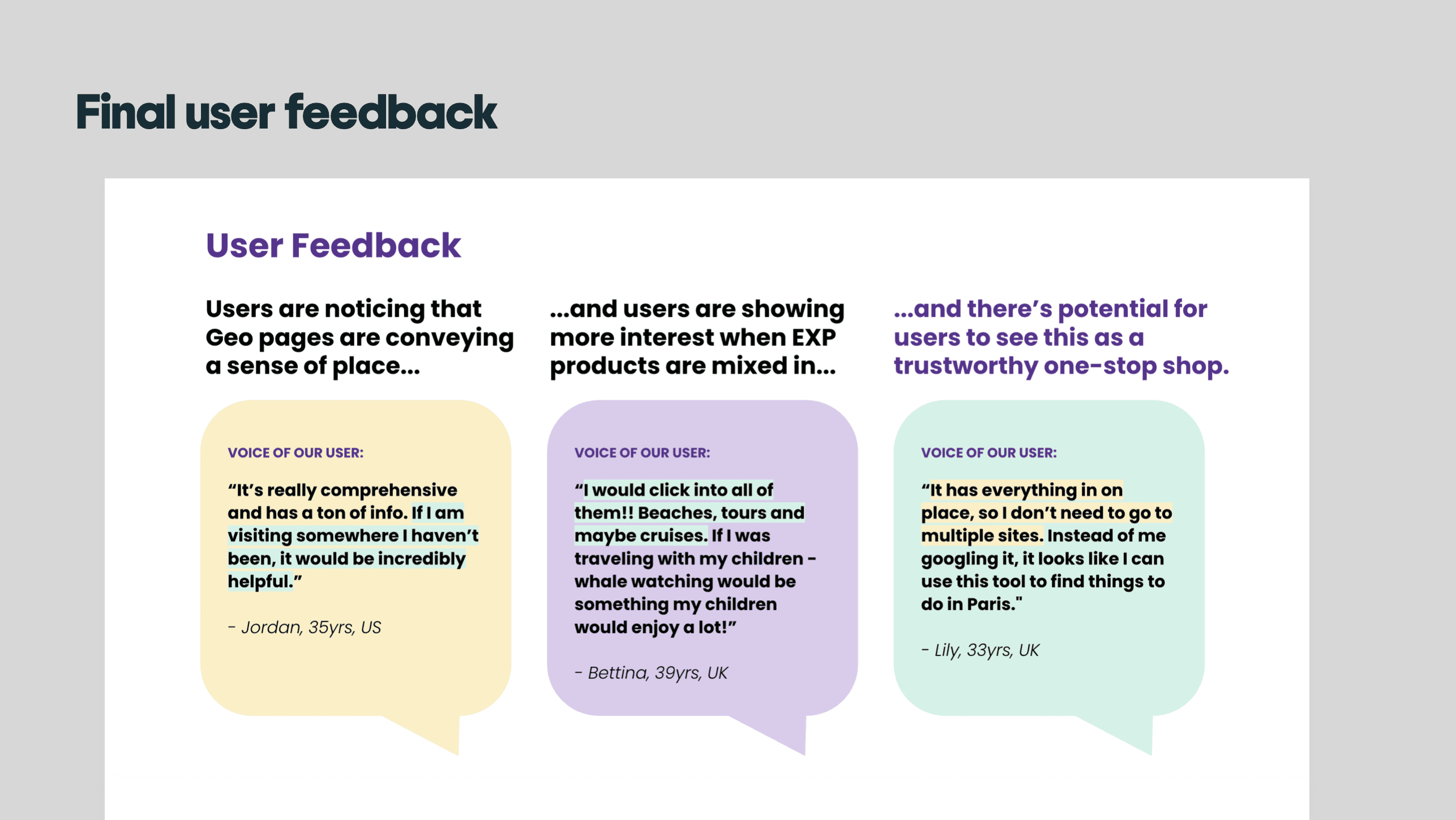
Analysis revealed several contributing factors to this low conversion. A primary issue was the pages’ lack of “sense of place.” They failed to effectively convey the unique character and appeal of the destinations, resulting in a generic and undifferentiated user experience. Furthermore, user feedback consistently highlighted that the pages were perceived as overwhelming due to a deluge of information, unclear in their presentation, and overtly sales-driven, rather than being helpful and informative. These combined issues created a less than ideal user journey, hindering visitors from progressing from research to booking.
In 2021, the Things To Do (TTD) geo (destination) pages successfully attracted a substantial audience of 193 million visitors, predominantly through organic search results on Google. Despite this impressive traffic volume, a significant challenge emerged: approximately 85% of these visitors were in the research phase of their travel planning and not immediately prepared to make a booking. This disparity between visitation and conversion was reflected in a low conversion rate of only around 11%.
Analysis revealed several contributing factors to this low conversion. A primary issue was the pages’ lack of “sense of place.” They failed to effectively convey the unique character and appeal of the destinations, resulting in a generic and undifferentiated user experience. Furthermore, user feedback consistently highlighted that the pages were perceived as overwhelming due to a deluge of information, unclear in their presentation, and overtly sales-driven, rather than being helpful and informative. These combined issues created a less than ideal user journey, hindering visitors from progressing from research to booking.
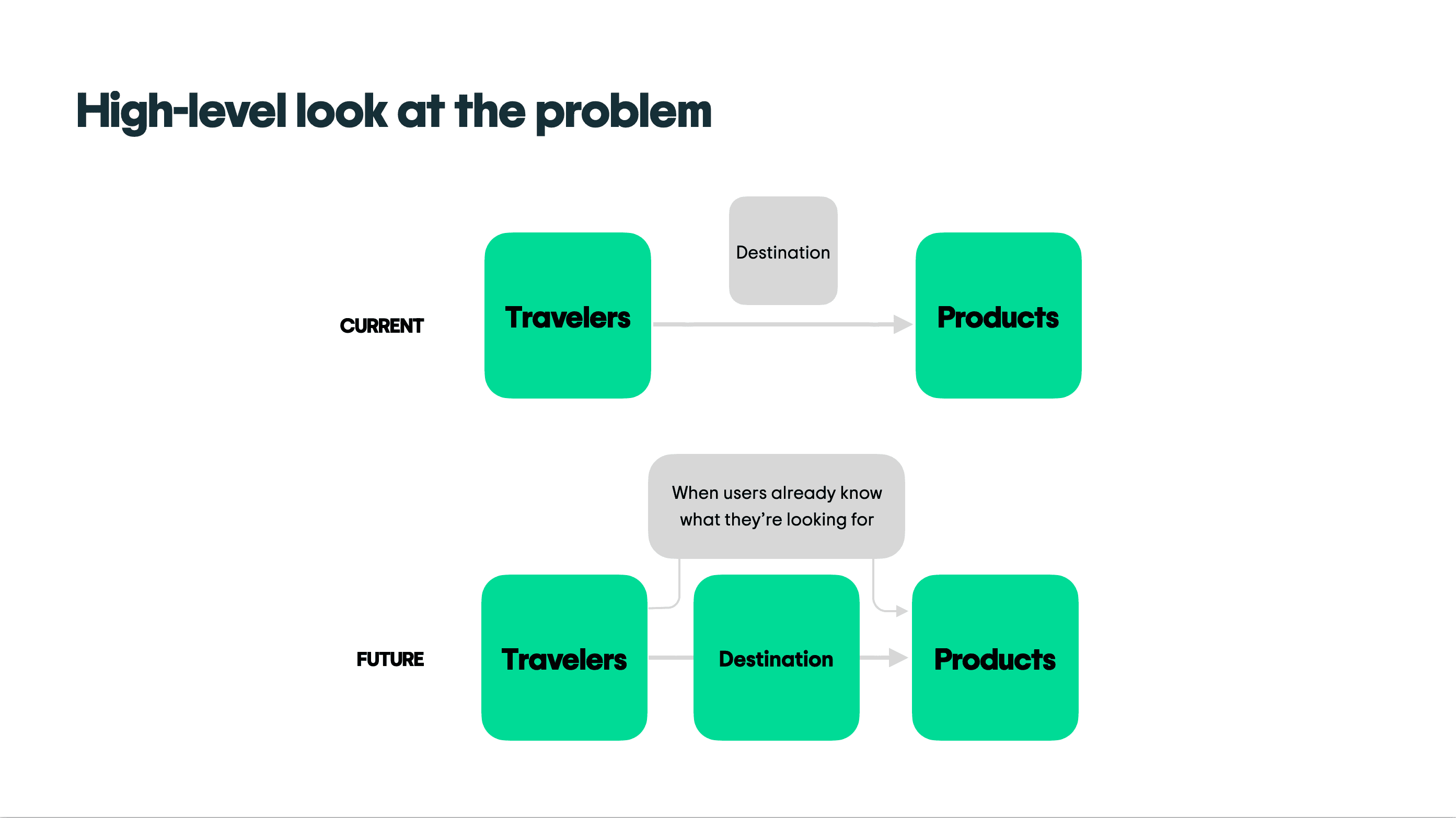
Our discovery pages skip education on destination almost entirely
Our discovery pages skip education on destination almost entirely
Challenges
Challenges
A major consideration for this project was how to balance between northstar and immediate improvements. We wanted to make sure that we work towards something we can experiment in the short-term while setting up long-term vision.
A major consideration for this project was how to balance between northstar and immediate improvements. We wanted to make sure that we work towards something we can experiment in the short-term while setting up long-term vision.
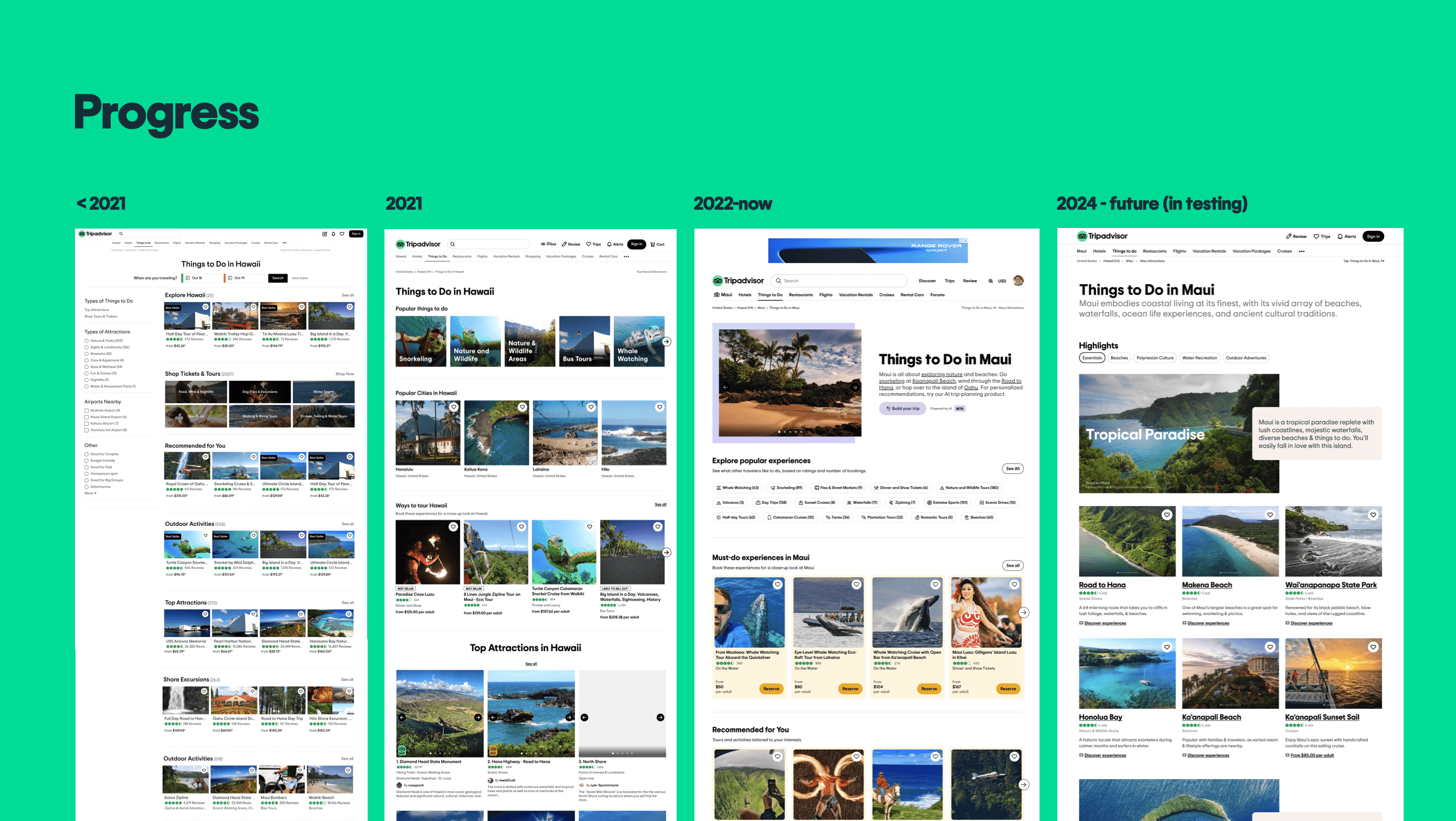
Balancing current, immediate and long-term vision
Balancing current, immediate and long-term vision
Other challenge was design system logistics. In setting up vision, developing the product within the existing design system presented a significant hurdle. A primary constraint was the absence of many desired components within the established system. This meant that crucial elements needed for optimal user experience and functionality were not readily available. Furthermore, the introduction of any new components was not a straightforward process; it necessitated extensive negotiation and collaboration with central design and development teams. This often led to delays and a more complex development cycle.
Beyond the technical limitations, a critical challenge lay in striking a delicate balance between competing priorities. On one hand, there was intense business pressure to drive conversions and meet ambitious commercial targets. This often pushed for more direct, conversion-focused design choices. On the other hand, it was equally important to cater to user needs, which emphasized providing inspiration, facilitating detailed planning, and offering a rich, engaging experience that might not always directly translate into immediate conversions. Navigating these two often-conflicting objectives required careful consideration and strategic design decisions to ensure both business success and user satisfaction.
Other challenge was design system logistics. In setting up vision, developing the product within the existing design system presented a significant hurdle. A primary constraint was the absence of many desired components within the established system. This meant that crucial elements needed for optimal user experience and functionality were not readily available. Furthermore, the introduction of any new components was not a straightforward process; it necessitated extensive negotiation and collaboration with central design and development teams. This often led to delays and a more complex development cycle.
Beyond the technical limitations, a critical challenge lay in striking a delicate balance between competing priorities. On one hand, there was intense business pressure to drive conversions and meet ambitious commercial targets. This often pushed for more direct, conversion-focused design choices. On the other hand, it was equally important to cater to user needs, which emphasized providing inspiration, facilitating detailed planning, and offering a rich, engaging experience that might not always directly translate into immediate conversions. Navigating these two often-conflicting objectives required careful consideration and strategic design decisions to ensure both business success and user satisfaction.
Approach
Approach
We are clear on focusing on upper funnel (geo or destination pages), defined metrics, and devised strategy: who to design for, and what their jobs-to-be-done are. We worked closely with product and user research teams to align on the first phase of the project.
We are clear on focusing on upper funnel (geo or destination pages), defined metrics, and devised strategy: who to design for, and what their jobs-to-be-done are. We worked closely with product and user research teams to align on the first phase of the project.
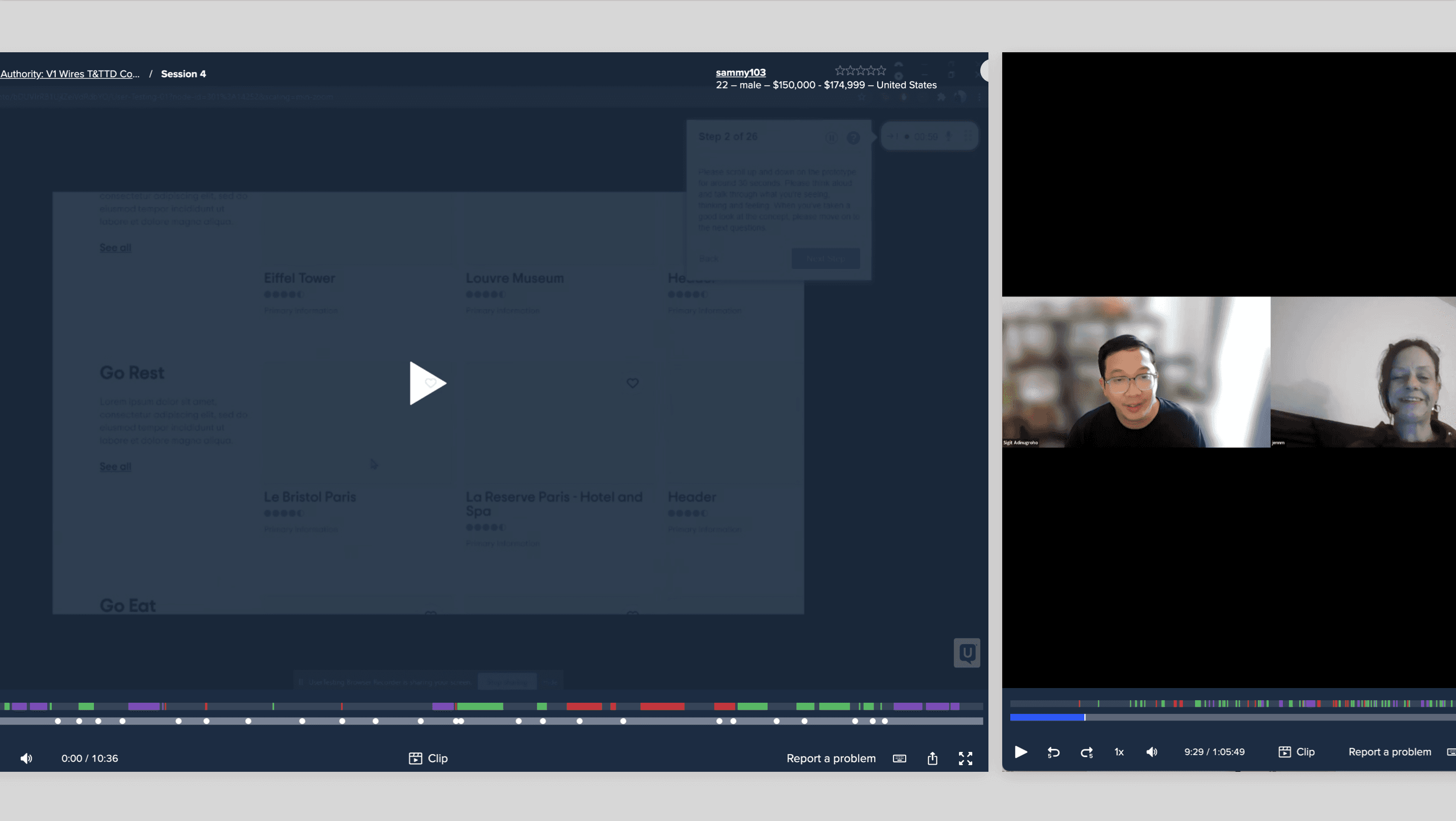
We audited upper, mid, and lower funnels, and mapped jobs-to-be-done for traveler archetypes. We ran multiple rounds of testing on UserTesting.com, gathering global traveler feedback. Prototypes explored new layouts emphasizing highlights, categories, and context before transitioning to bookable activities. We also benchmarked other travel and commerce sites for inspiration.We conducted a comprehensive audit of the upper, mid, and lower funnels, meticulously mapping out jobs-to-be-done for various traveler archetypes. To gather global traveler feedback, we ran multiple rounds of testing on UserTesting.com. Our prototypes explored innovative layouts that highlighted key features, categorized information effectively, and provided ample context before guiding users to bookable activities. Additionally, we benchmarked other leading travel and commerce websites for inspiration.
We audited upper, mid, and lower funnels, and mapped jobs-to-be-done for traveler archetypes. We ran multiple rounds of testing on UserTesting.com, gathering global traveler feedback. Prototypes explored new layouts emphasizing highlights, categories, and context before transitioning to bookable activities. We also benchmarked other travel and commerce sites for inspiration.We conducted a comprehensive audit of the upper, mid, and lower funnels, meticulously mapping out jobs-to-be-done for various traveler archetypes. To gather global traveler feedback, we ran multiple rounds of testing on UserTesting.com. Our prototypes explored innovative layouts that highlighted key features, categorized information effectively, and provided ample context before guiding users to bookable activities. Additionally, we benchmarked other leading travel and commerce websites for inspiration.
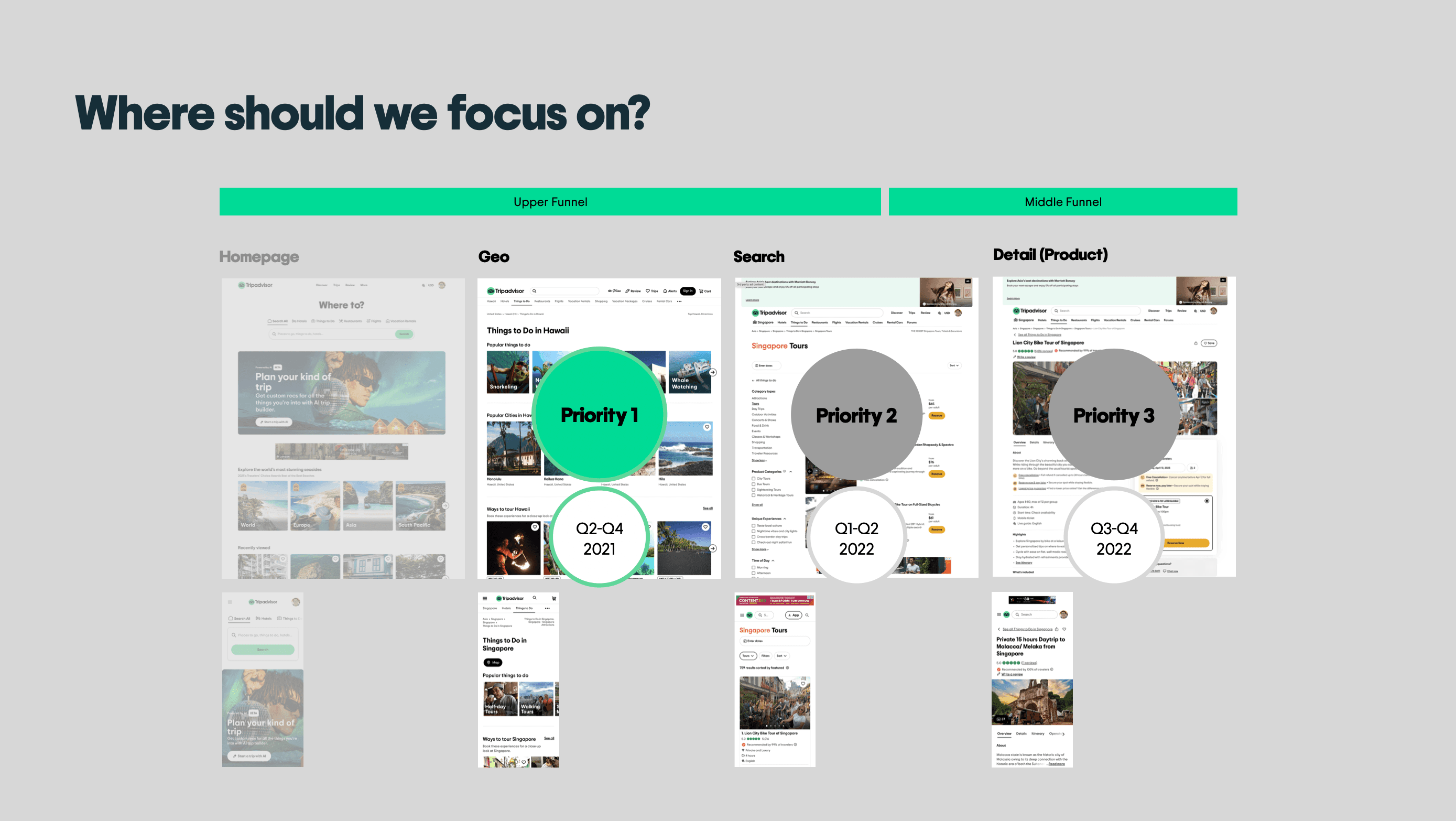
We needed to align on which areas we tackle first, and we aligned on discovery phase (upper funnel)
We needed to align on which areas we tackle first, and we aligned on discovery phase (upper funnel)
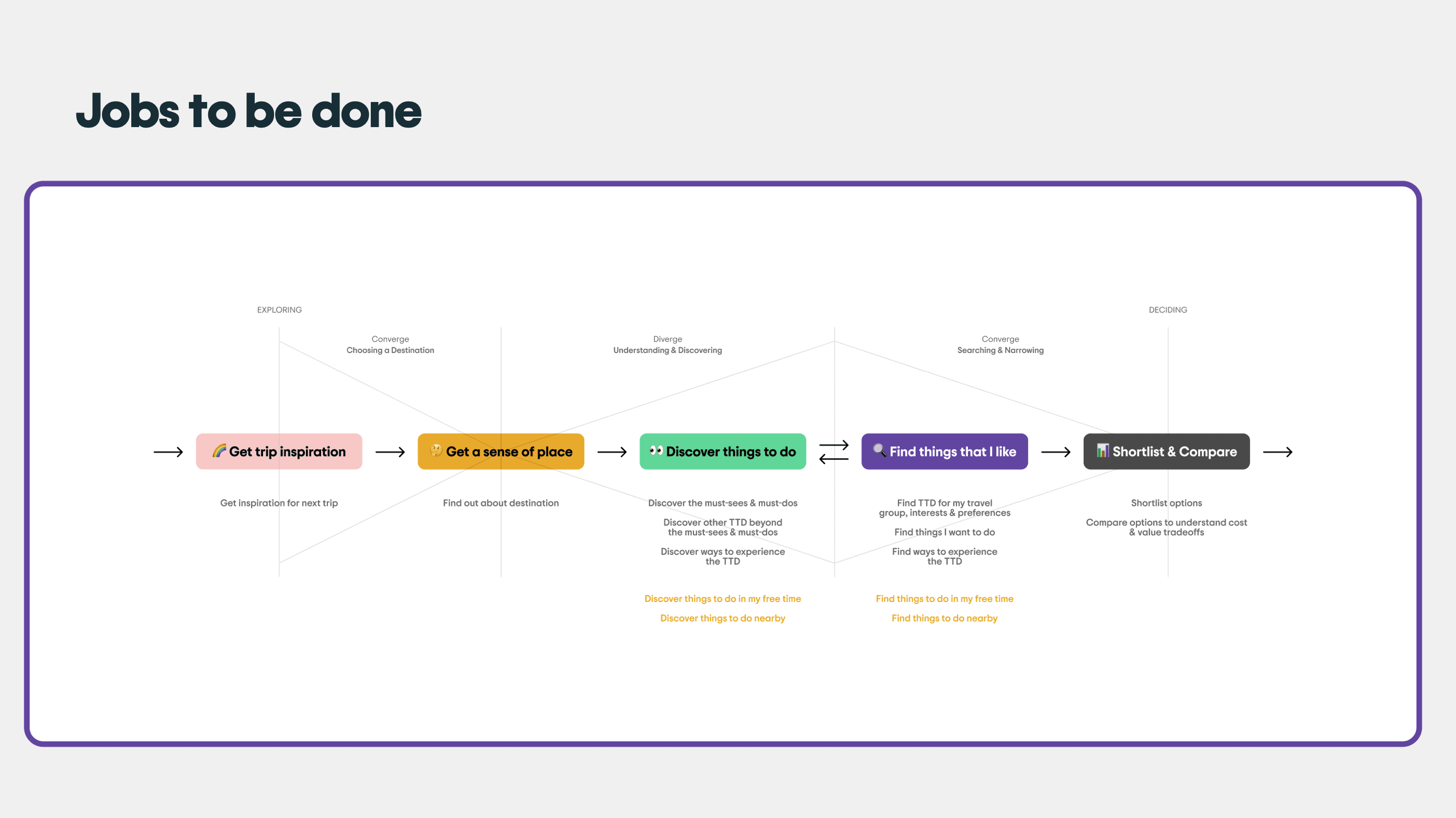
Before we dive deep into design, we need to know the user mental model
Before we dive deep into design, we need to know the user mental model
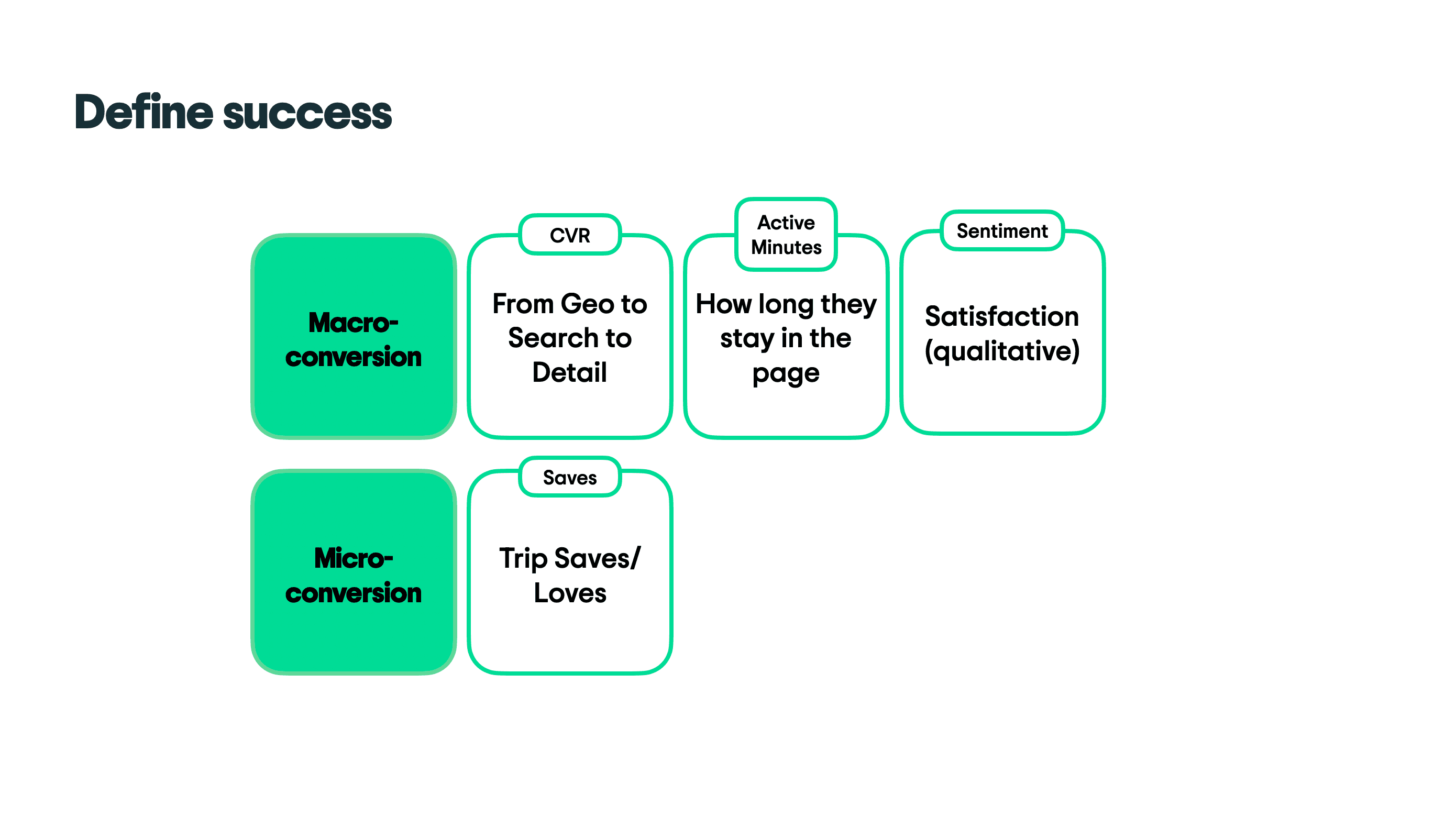
Other than understanding users, we need to align on the specific metrics for success
Other than understanding users, we need to align on the specific metrics for success
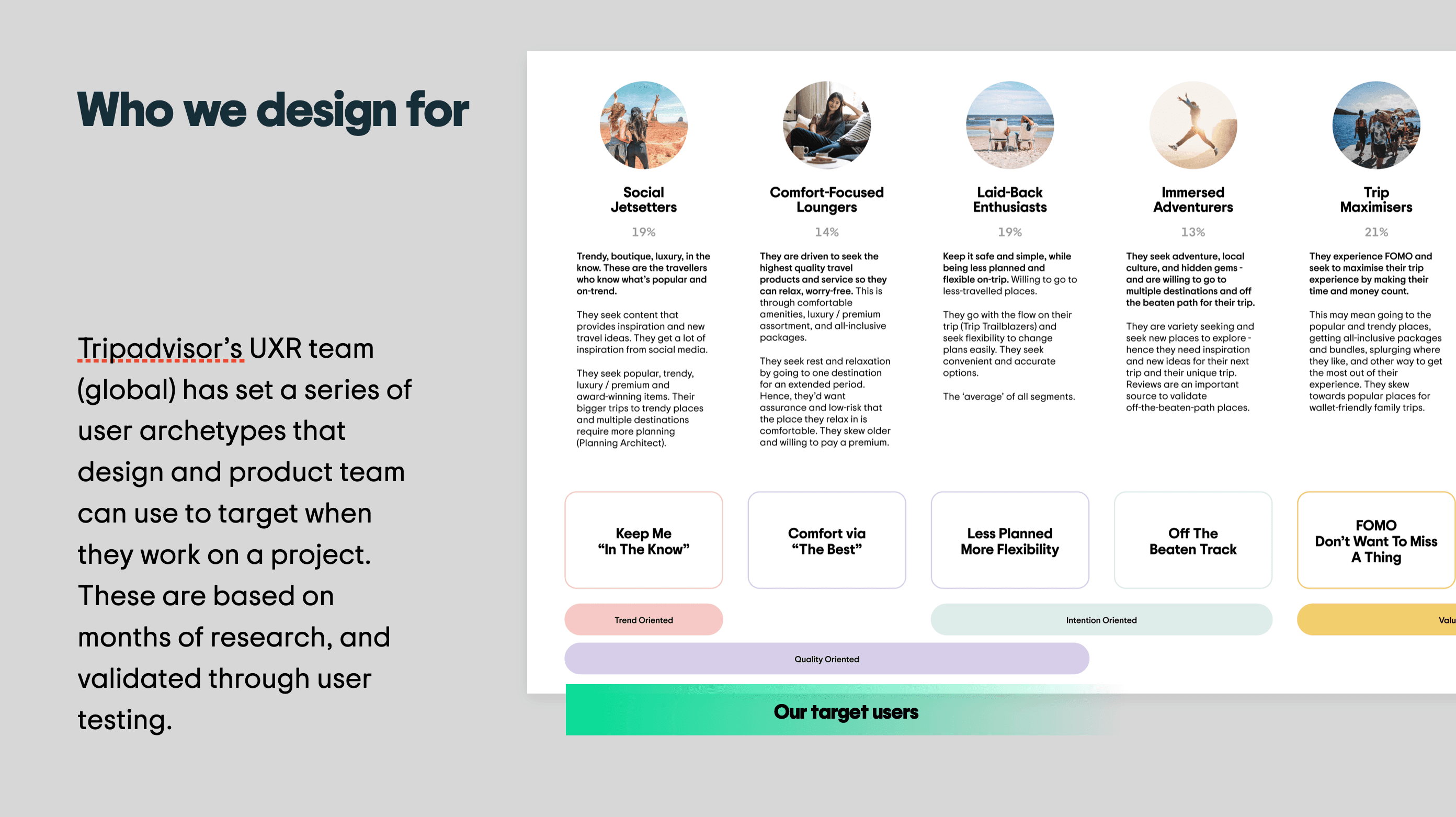
Using user archetypes as proposed by our UX Research team, we aligned on those users that are leading the trip and those focus on quality
Using user archetypes as proposed by our UX Research team, we aligned on those users that are leading the trip and those focus on quality
We did competitive review. We found out that competitors have mixed ways to lead their users in the discovery stage.
Airbnb does it in a subtle, educational way. This can be seen in their Animals tourism page that educates what it is about animal tourism that is important, before even leading users into buying.
GetYourGuide does have context-setting page before they lead users into the bookable items page.
CTrip (from China) has more aggressive selling tactics.
We did competitive review. We found out that competitors have mixed ways to lead their users in the discovery stage.
Airbnb does it in a subtle, educational way. This can be seen in their Animals tourism page that educates what it is about animal tourism that is important, before even leading users into buying.
GetYourGuide does have context-setting page before they lead users into the bookable items page.
CTrip (from China) has more aggressive selling tactics.
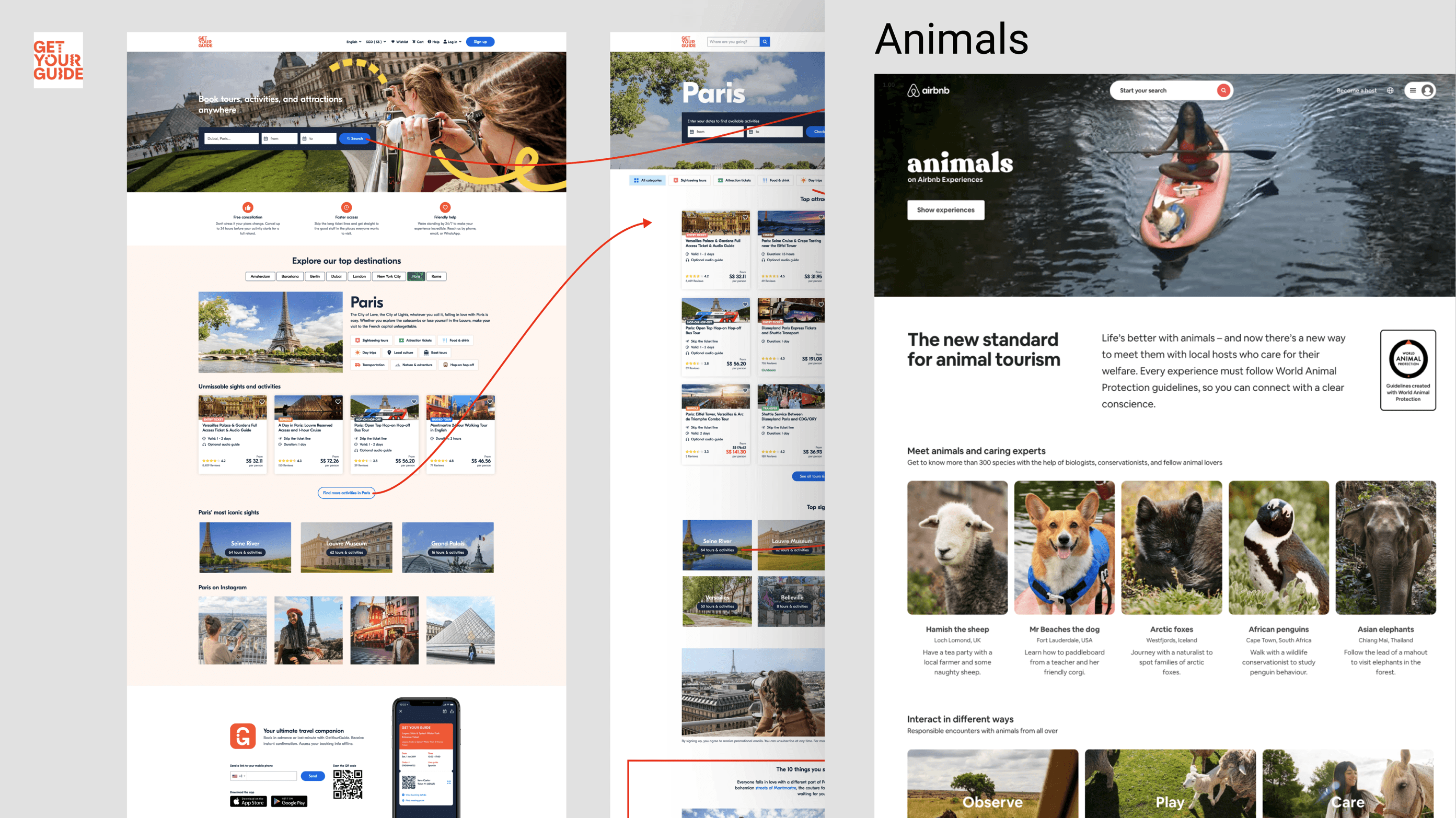
Benchmarking against main coompetitors: GetYourGuide and Airbnb Experiences
Benchmarking against main coompetitors: GetYourGuide and Airbnb Experiences
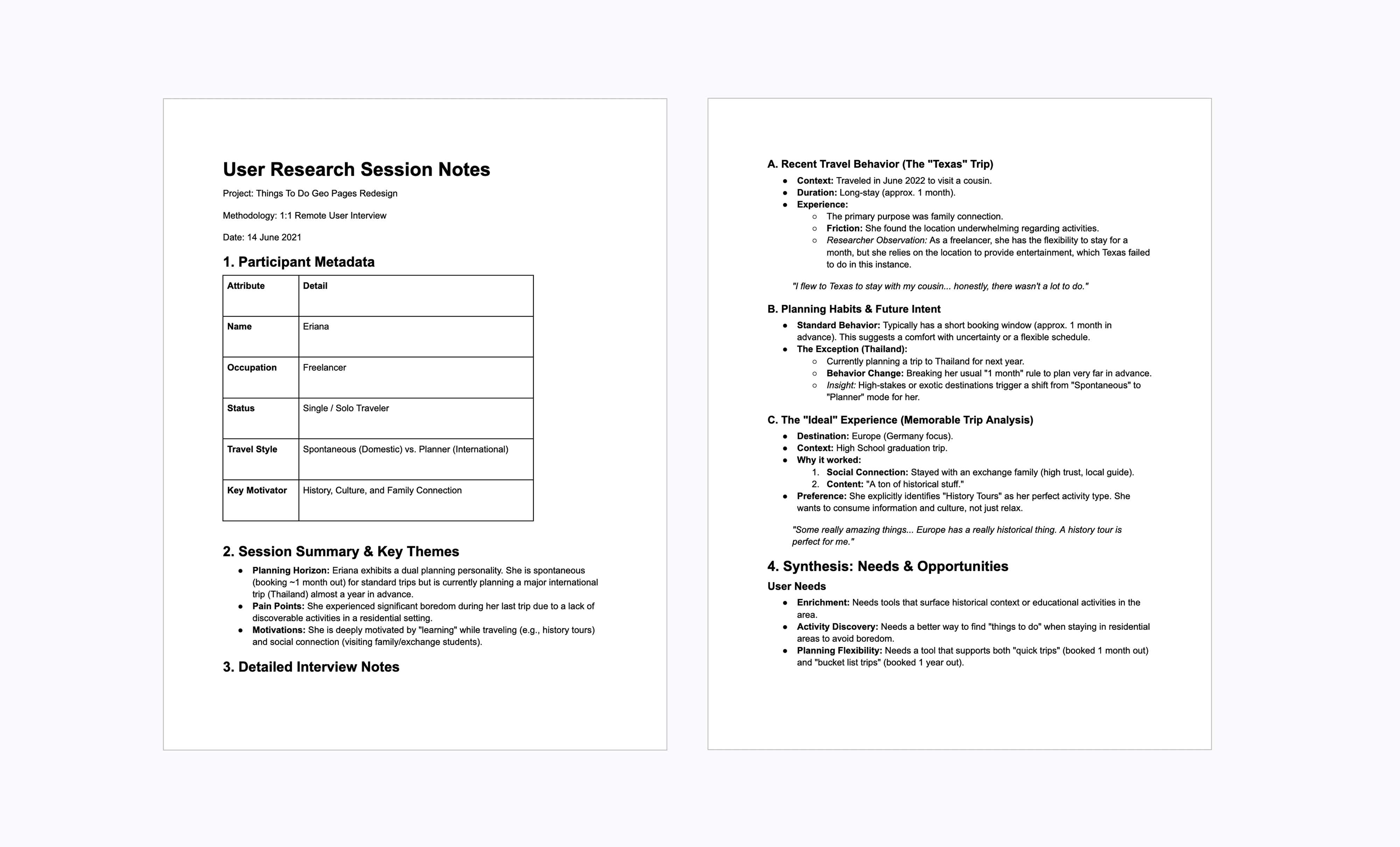
This was followed by rigorous concept testing, where various product ideas were evaluated for their appeal and feasibility.
We defined page structure, and tested that in front of users over a period of 3-4 weeks. We iterated based on feedback through rapid prototyping.
This was followed by rigorous concept testing, where various product ideas were evaluated for their appeal and feasibility.
We defined page structure, and tested that in front of users over a period of 3-4 weeks. We iterated based on feedback through rapid prototyping.
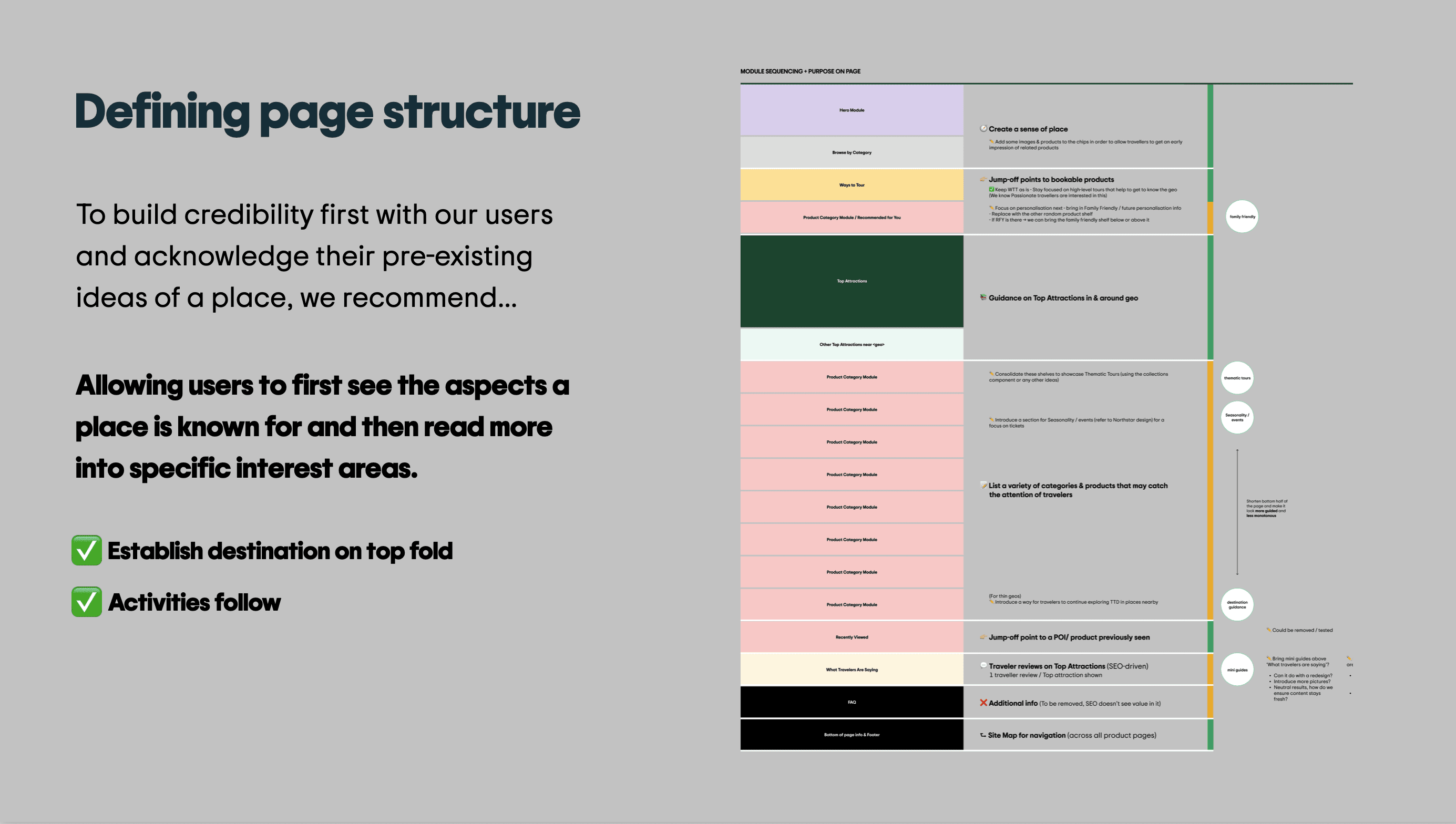
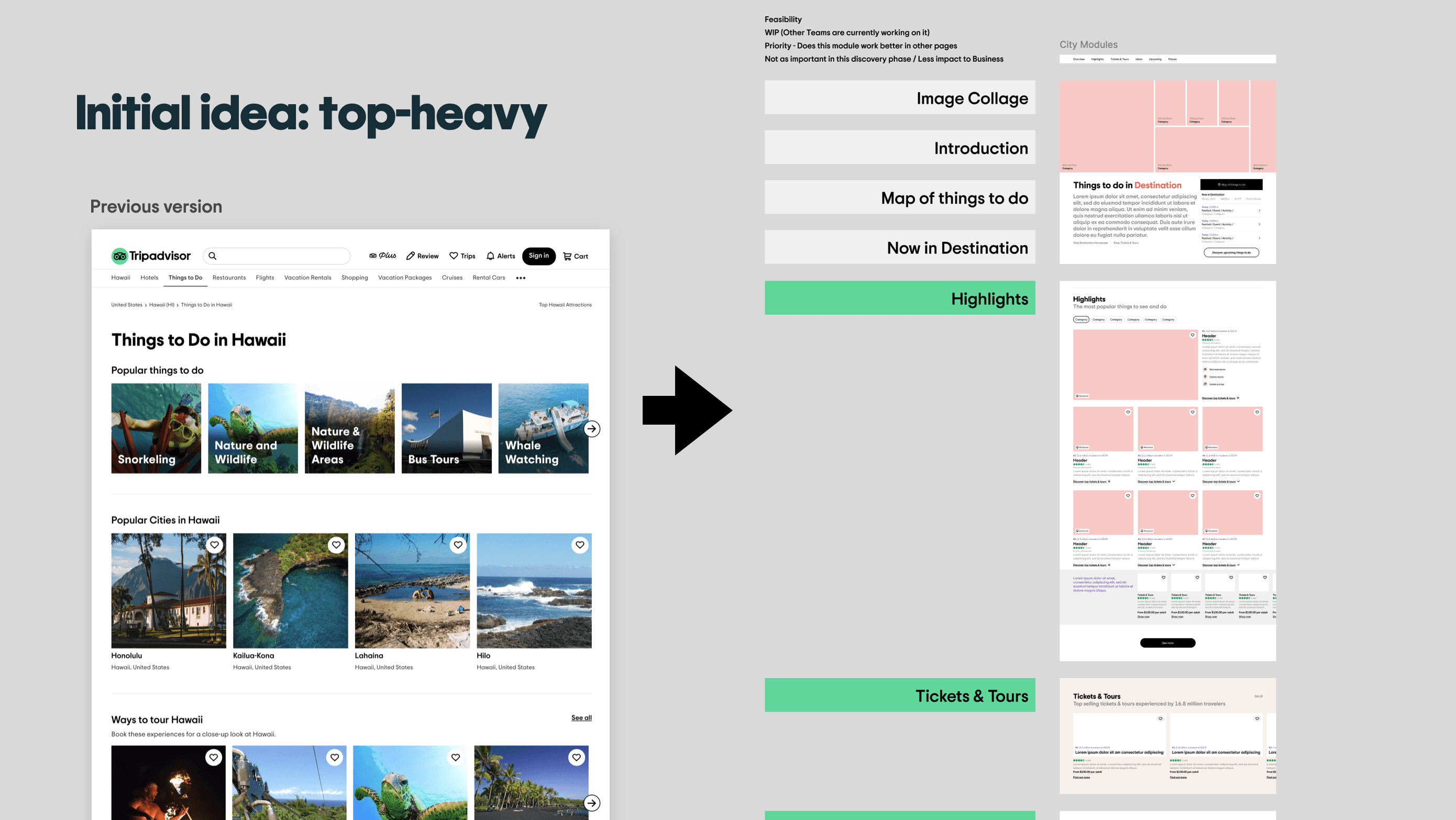
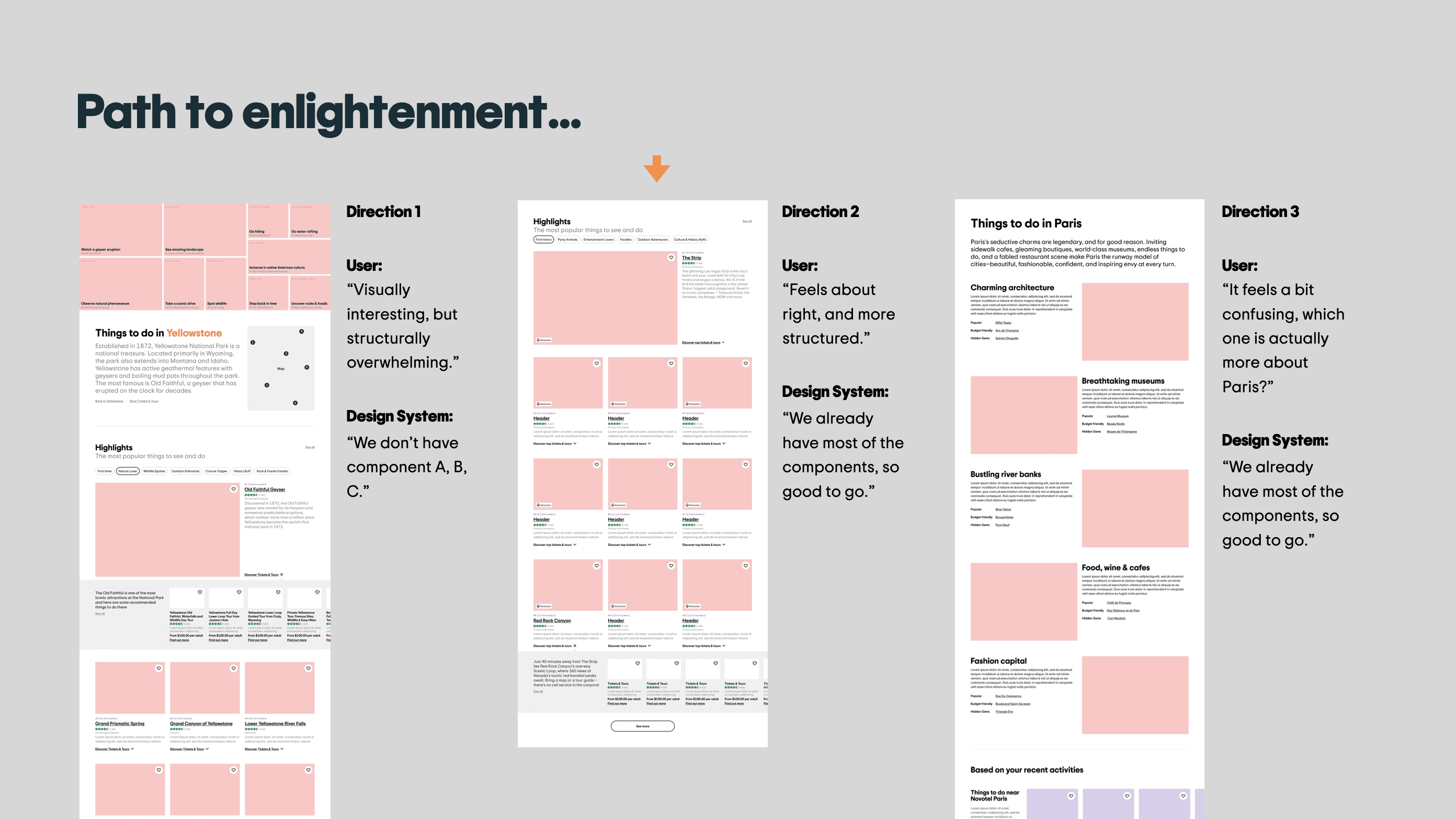
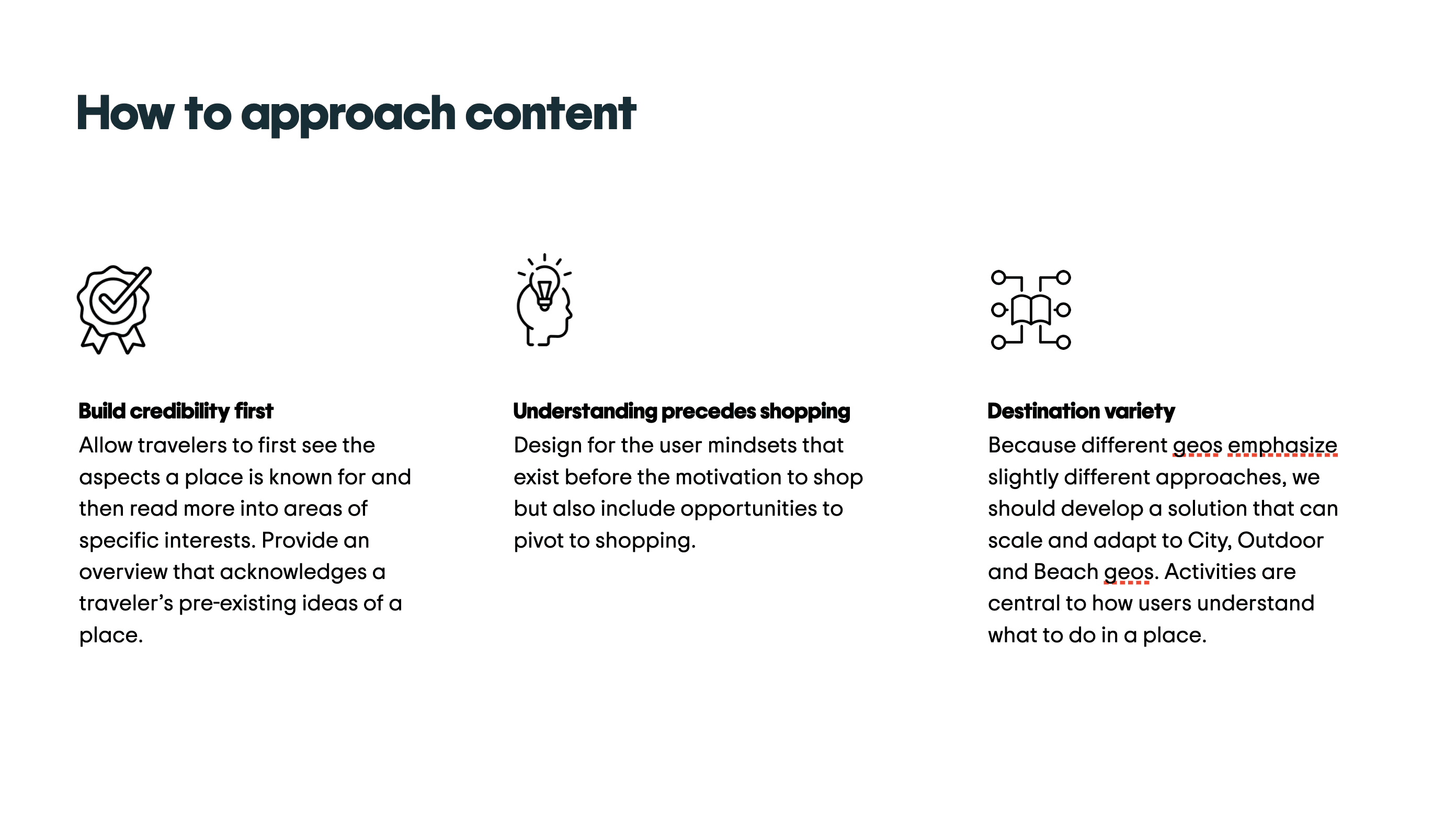
From initial assumption to validation with users
From initial assumption to validation with users
Prototype example that we tested to users
Prototype example that we tested to users
Solution
Solution
We redesigned geo pages with a structure that began with essentials and highlights, then expanded into categories of activities. This created a narrative flow that acknowledged traveler mindsets before nudging toward booking.
We redesigned geo pages with a structure that began with essentials and highlights, then expanded into categories of activities. This created a narrative flow that acknowledged traveler mindsets before nudging toward booking.
Copy and content design were updated to emphasize guidance rather than hard selling. We revamped our geo pages to create a more intuitive and user-centric experience. The new structure prioritizes essential information and key highlights, gradually expanding into different categories of activities. This approach fosters a natural narrative flow, addressing traveler considerations before gently guiding them toward booking options. We also refined the copy and content design to focus on providing helpful guidance and inspiration rather than employing overt sales tactics. To make sure that we design something in a feasible way, we define phases of design updates from MVP to northstar design.
Copy and content design were updated to emphasize guidance rather than hard selling. We revamped our geo pages to create a more intuitive and user-centric experience. The new structure prioritizes essential information and key highlights, gradually expanding into different categories of activities. This approach fosters a natural narrative flow, addressing traveler considerations before gently guiding them toward booking options. We also refined the copy and content design to focus on providing helpful guidance and inspiration rather than employing overt sales tactics. To make sure that we design something in a feasible way, we define phases of design updates from MVP to northstar design.
Immediate improvements
Immediate improvements
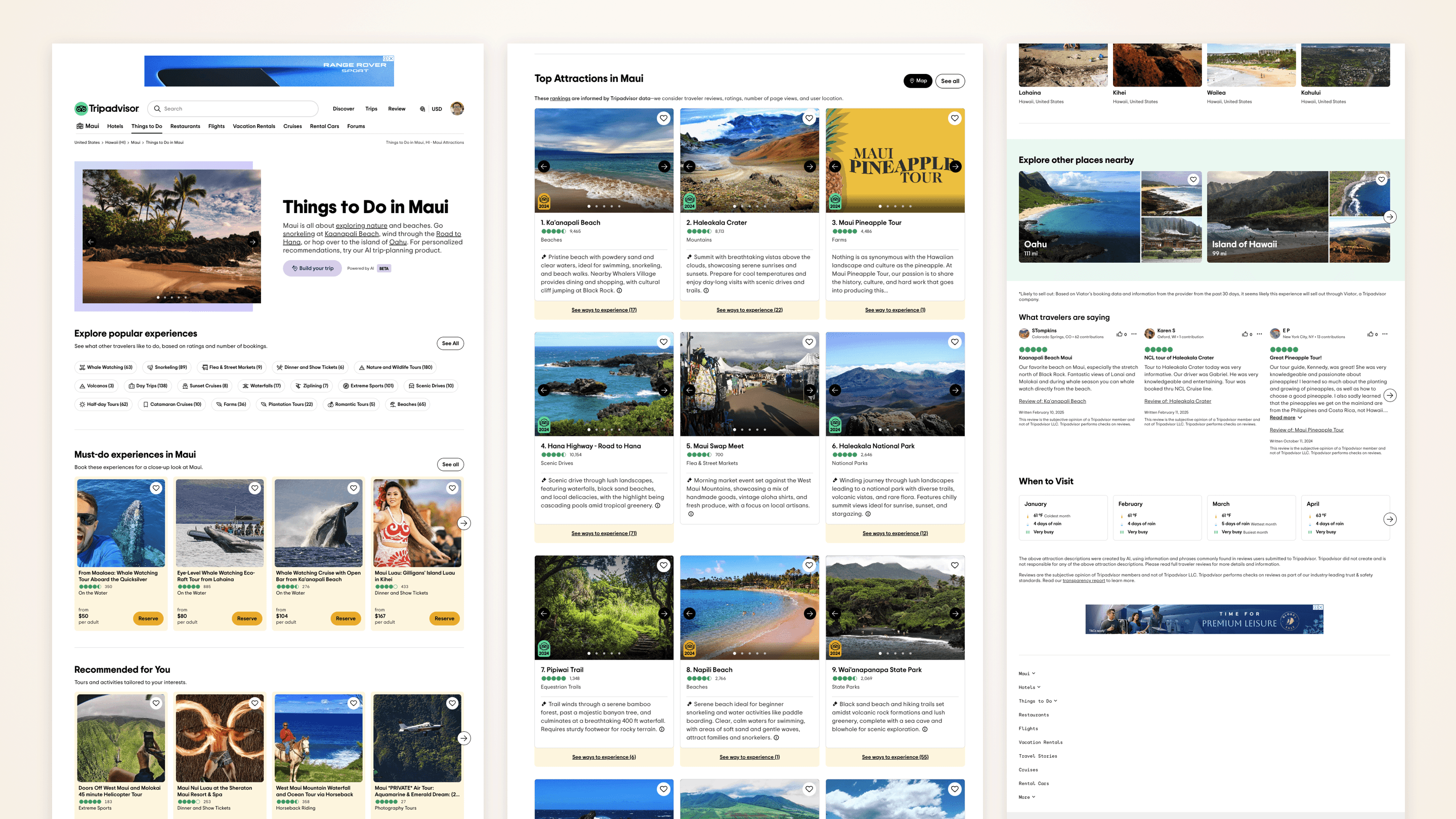
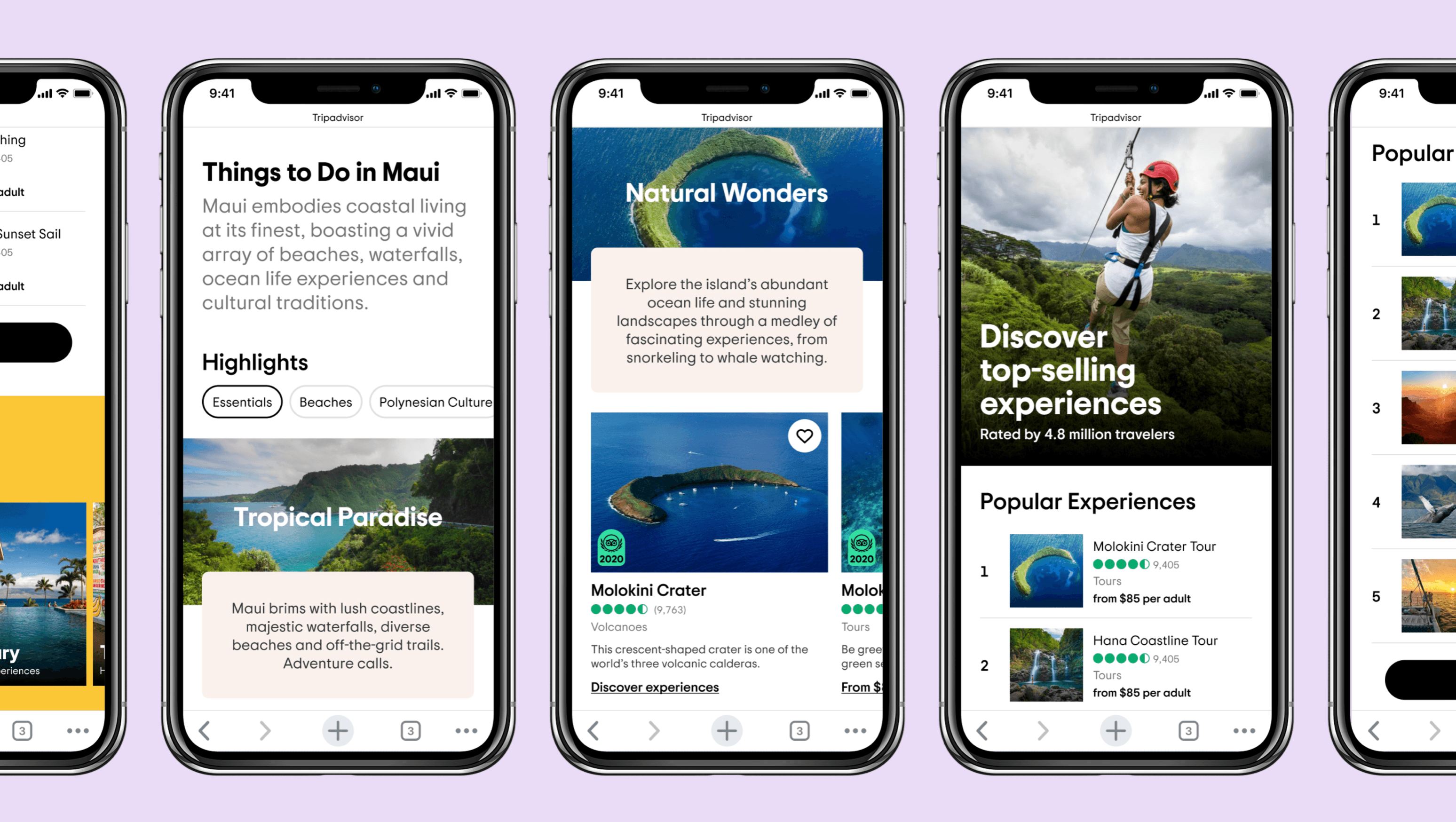
We worked with engineering and product to launch an immediate improvement, mainly with a hero area that gives a full context of the geo, linking it into different points of interest.
We worked with engineering and product to launch an immediate improvement, mainly with a hero area that gives a full context of the geo, linking it into different points of interest.
The immediate design includes major improvement on the header area, and redesigned bookable sections
The immediate design includes major improvement on the header area, and redesigned bookable sections
We also worked with the Native Mobile team to introduce the same architecture and flow
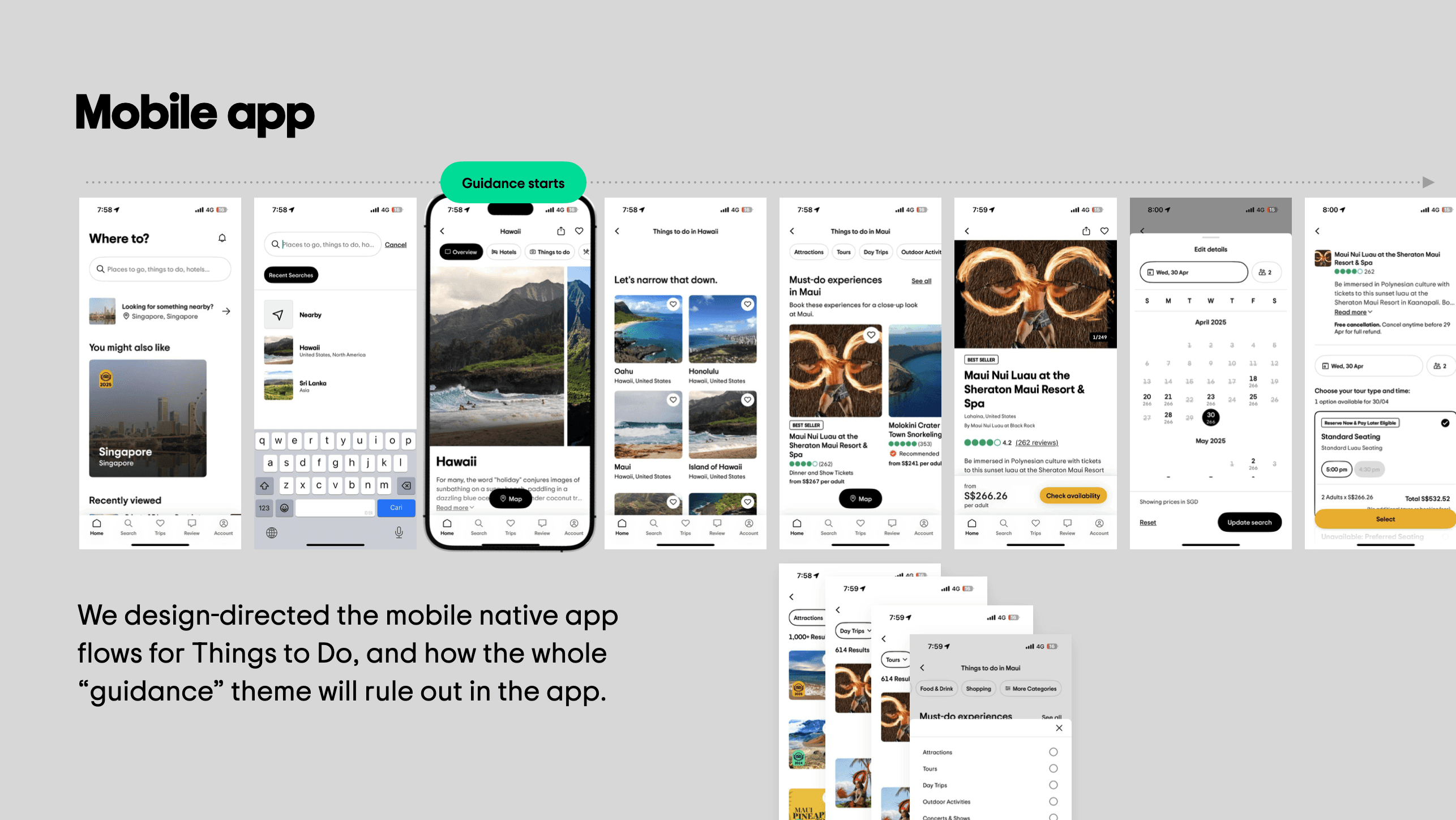
We also worked with the Native Mobile team to introduce the same architecture and flow
Northstar design
Northstar design
The northstar design serves as a guiding version that we want to achieve in the long-term.
The northstar design serves as a guiding version that we want to achieve in the long-term.
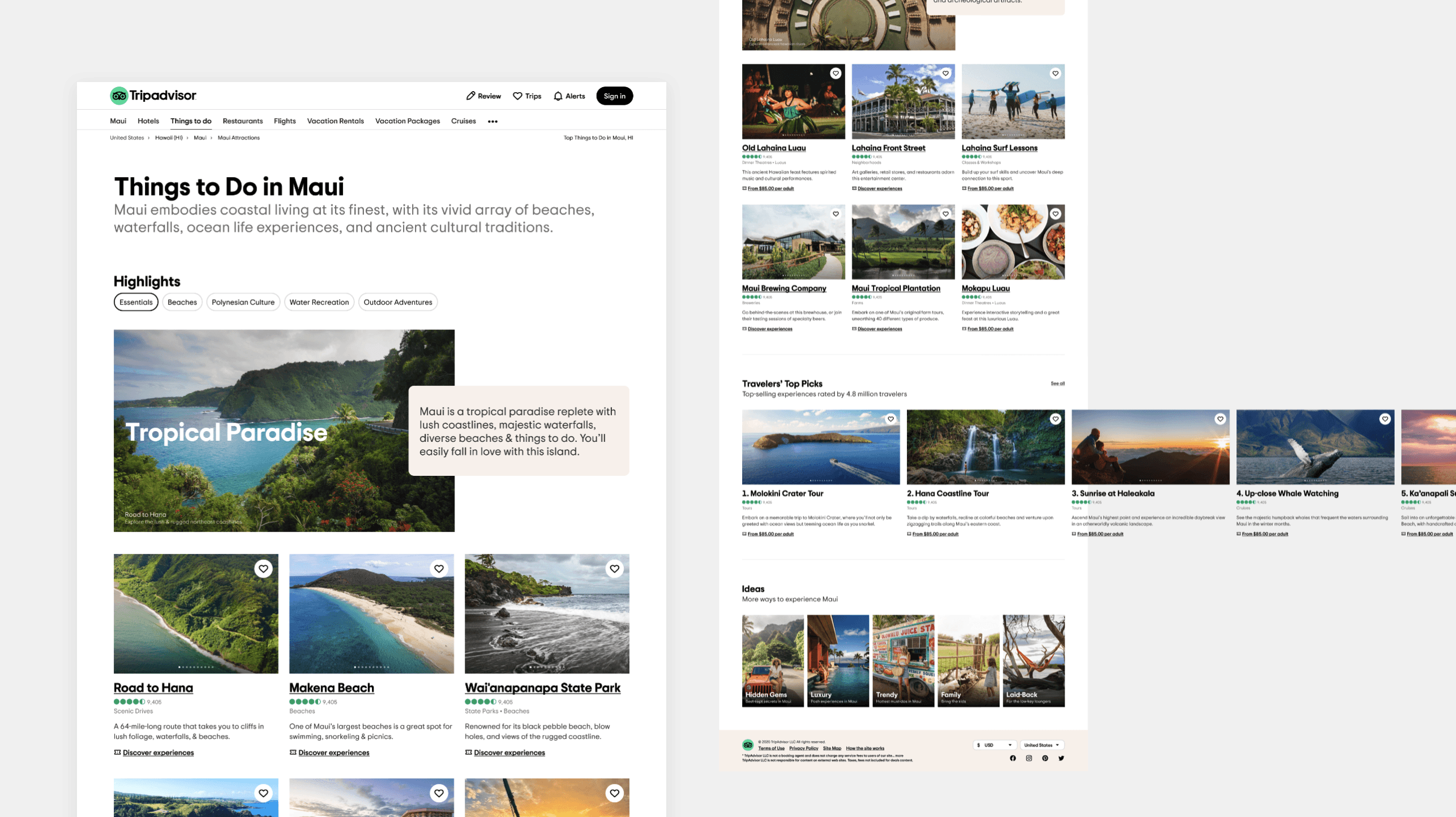
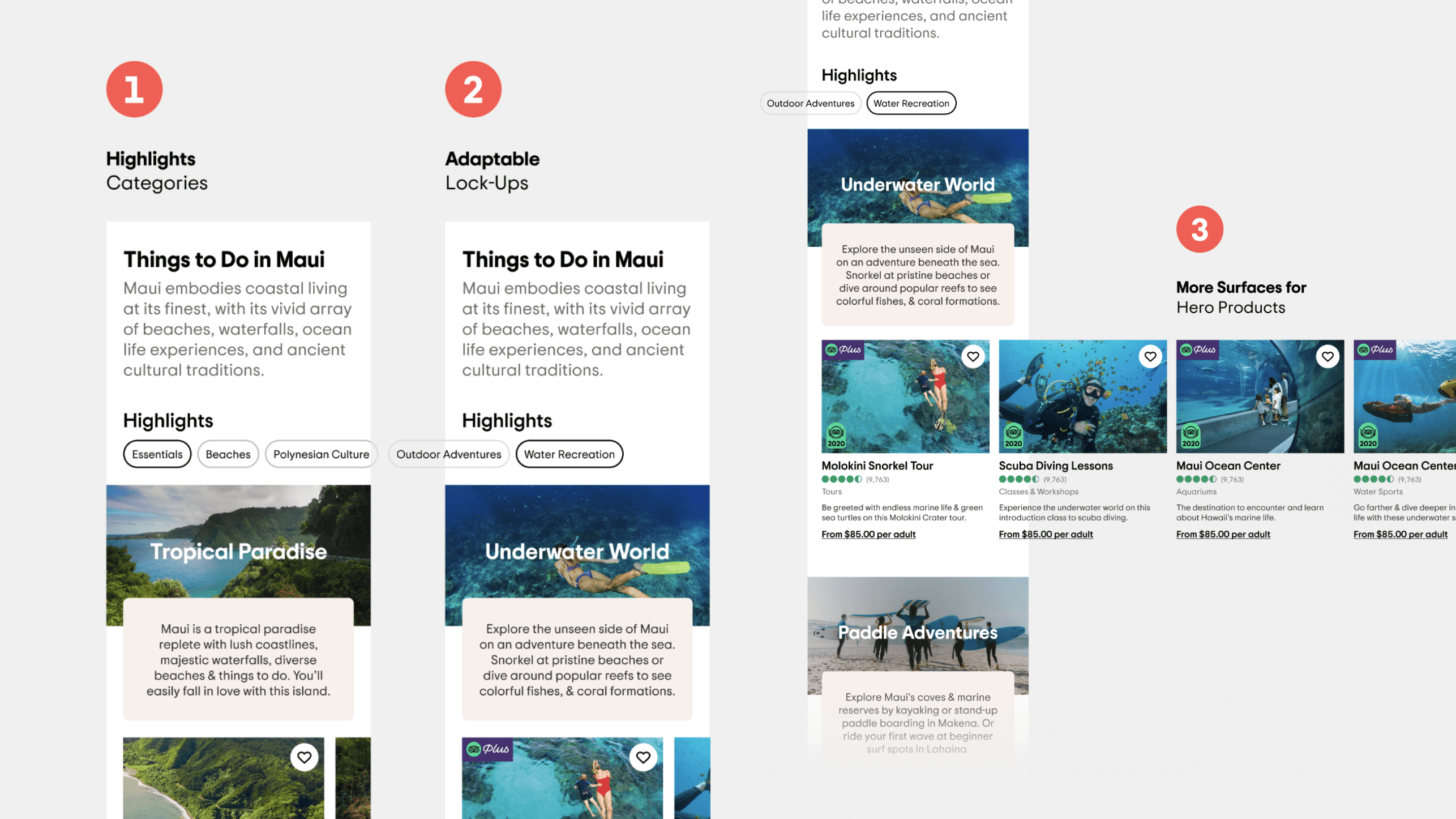
We used staged approach to reach the northstar, and implemented the following on the same year.
We used staged approach to reach the northstar, and implemented the following on the same year.
Balancing current, immediate and long-term vision
Balancing current, immediate and long-term vision
Outcomes
Outcomes
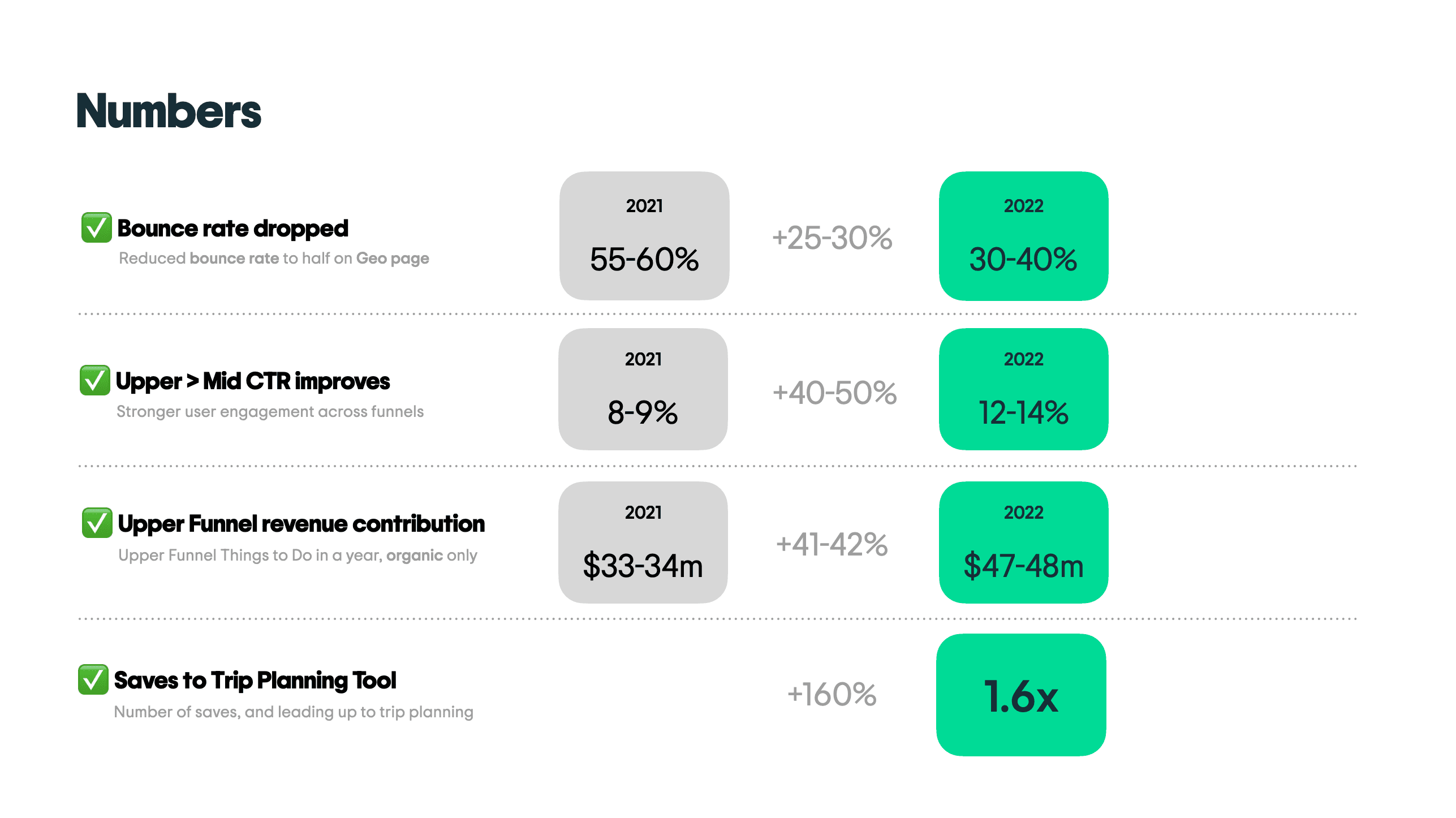
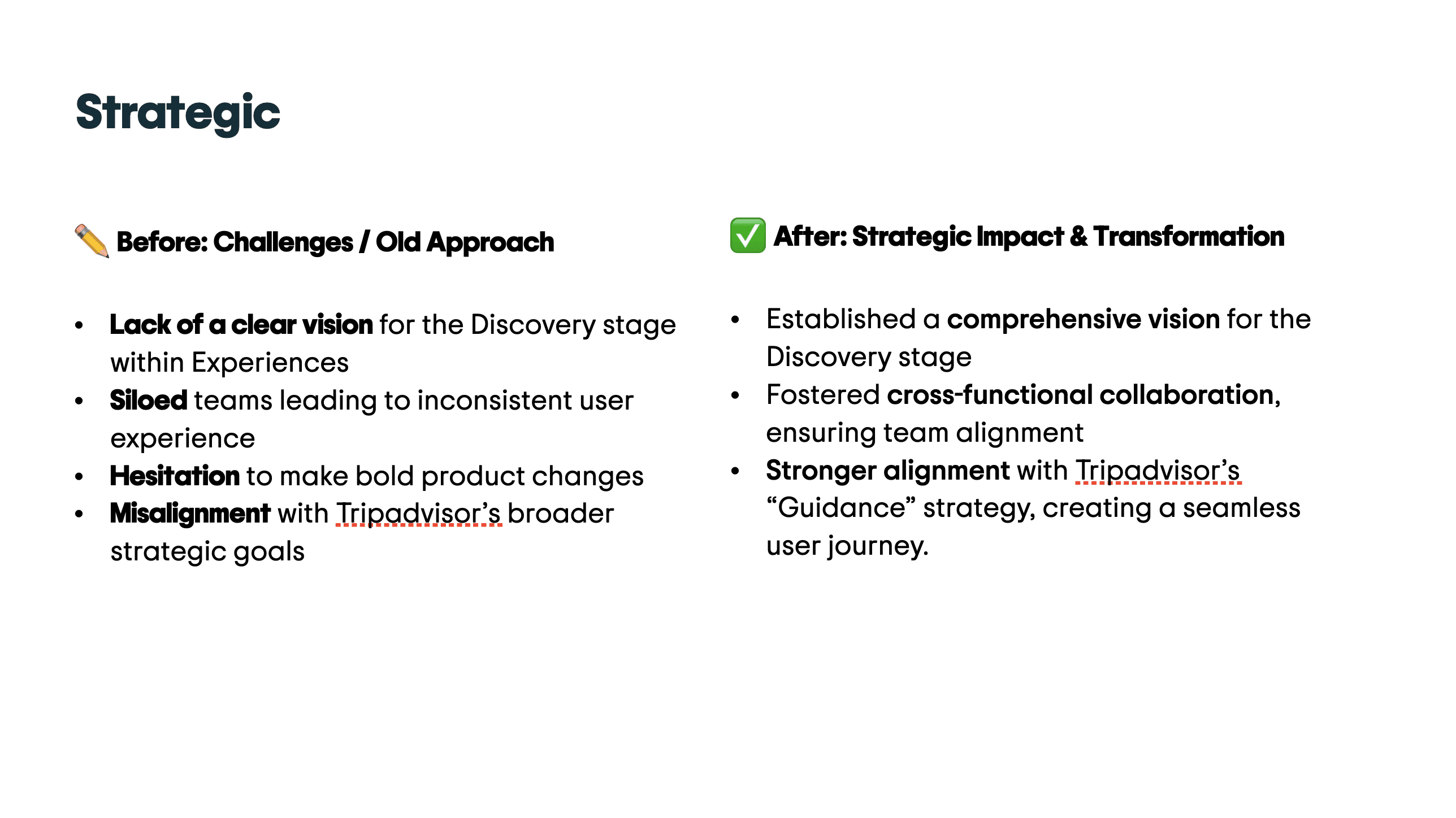
The redesign lowered bounce rates, increased time on page, and clarified booking pathways. Beyond metrics, the project shifted internal understanding: upper funnel design was recognized as critical, not optional. The work influenced Tripadvisor’s broader approach to inspirational discovery across multiple verticals.
The redesign lowered bounce rates, increased time on page, and clarified booking pathways. Beyond metrics, the project shifted internal understanding: upper funnel design was recognized as critical, not optional. The work influenced Tripadvisor’s broader approach to inspirational discovery across multiple verticals.
We're also proud that this work has led the team to be permanently assigned to Experiences/Things To Do business unit from 2022 onwards, and we had the opportunity to improve mid- and lower funnel items as well.
We're also proud that this work has led the team to be permanently assigned to Experiences/Things To Do business unit from 2022 onwards, and we had the opportunity to improve mid- and lower funnel items as well.