HomeAway (an Expedia company)
HomeAway (an Expedia company)
Bridging cultures, building trust
Bridging cultures, building trust
Company: HomeAway (an Expedia company)
Teammates: Mathew Wong, Karl Steiner
Company: HomeAway (an Expedia company)
Teammates: Mathew Wong, Karl Steiner
Duration: Q3-Q4 2018, Q1-Q2 2019
Deliverables: Design playbook, experiments
Duration: Q3-Q4 2018, Q1-Q2 2019
Deliverables: Design playbook, experiments
Summary
Summary
To capture the lucrative Japanese travel market, HomeAway realized its global platform was failing to build user trust due to a lack of cultural and linguistic alignment. Through immersive on-site research in Tokyo and Nagano, the design team uncovered distinct local preferences for high-density information, hierarchical map browsing, and specific real estate terminology. The team implemented localized typography, proper address formats, and culturally accurate property configurations, documenting these standards in a scalable "Japan Design Playbook". These strategic, market-specific adaptations ultimately improved the Japanese checkout conversion rate by 12% and generated positive reviews from domestic travelers.
To capture the lucrative Japanese travel market, HomeAway realized its global platform was failing to build user trust due to a lack of cultural and linguistic alignment. Through immersive on-site research in Tokyo and Nagano, the design team uncovered distinct local preferences for high-density information, hierarchical map browsing, and specific real estate terminology. The team implemented localized typography, proper address formats, and culturally accurate property configurations, documenting these standards in a scalable "Japan Design Playbook". These strategic, market-specific adaptations ultimately improved the Japanese checkout conversion rate by 12% and generated positive reviews from domestic travelers.
Background
Background
In 2018-2019, HomeAway (now part of Expedia Group) was a vacation rental juggernaut with 28 million unique monthly visitors, 1.1+ million listings, and annual gross bookings exceeding $4 billion globally. The Asia Pacific market, particularly Japan, represented a highly lucrative expansion target boasting 31 million inbound foreign tourists and a domestic travel spend of over 20 trillion JPY. However, local competitors and Airbnb (which held a $3.5 billion footprint) were dominating the space. HomeAway’s global UI simply did not align with Japanese cultural and digital expectations, leading to friction in trust, navigation, and usability.
In 2018-2019, HomeAway (now part of Expedia Group) was a vacation rental juggernaut with 28 million unique monthly visitors, 1.1+ million listings, and annual gross bookings exceeding $4 billion globally. The Asia Pacific market, particularly Japan, represented a highly lucrative expansion target boasting 31 million inbound foreign tourists and a domestic travel spend of over 20 trillion JPY. However, local competitors and Airbnb (which held a $3.5 billion footprint) were dominating the space. HomeAway’s global UI simply did not align with Japanese cultural and digital expectations, leading to friction in trust, navigation, and usability.
Problem
Problem
To understand the disconnect, the design team conducted rigorous on-site research in two distinct Japanese markets: Tokyo (urban/nature tourism) and Nagano (rural/winter tourism). They ran 90-minute in-depth interviews and usability tests with 16 participants, splitting the cohort between property partners (hosts) and travelers. The findings were stark. The team discovered that Japanese digital consumers are accustomed to high information density—exemplified by Yahoo! Japan's text-heavy, 90s-era aesthetic, which remained immensely popular. Culturally, Japanese travelers prioritize meticulous planning and trust, often leaning toward traditional hotels because they are perceived as more reliable. Furthermore, Asian travelers frequently embrace communal living to maximize bonding and space optimization, making highly specific property details critical to their booking decisions.
Strategy and Execution
Strategy and Execution
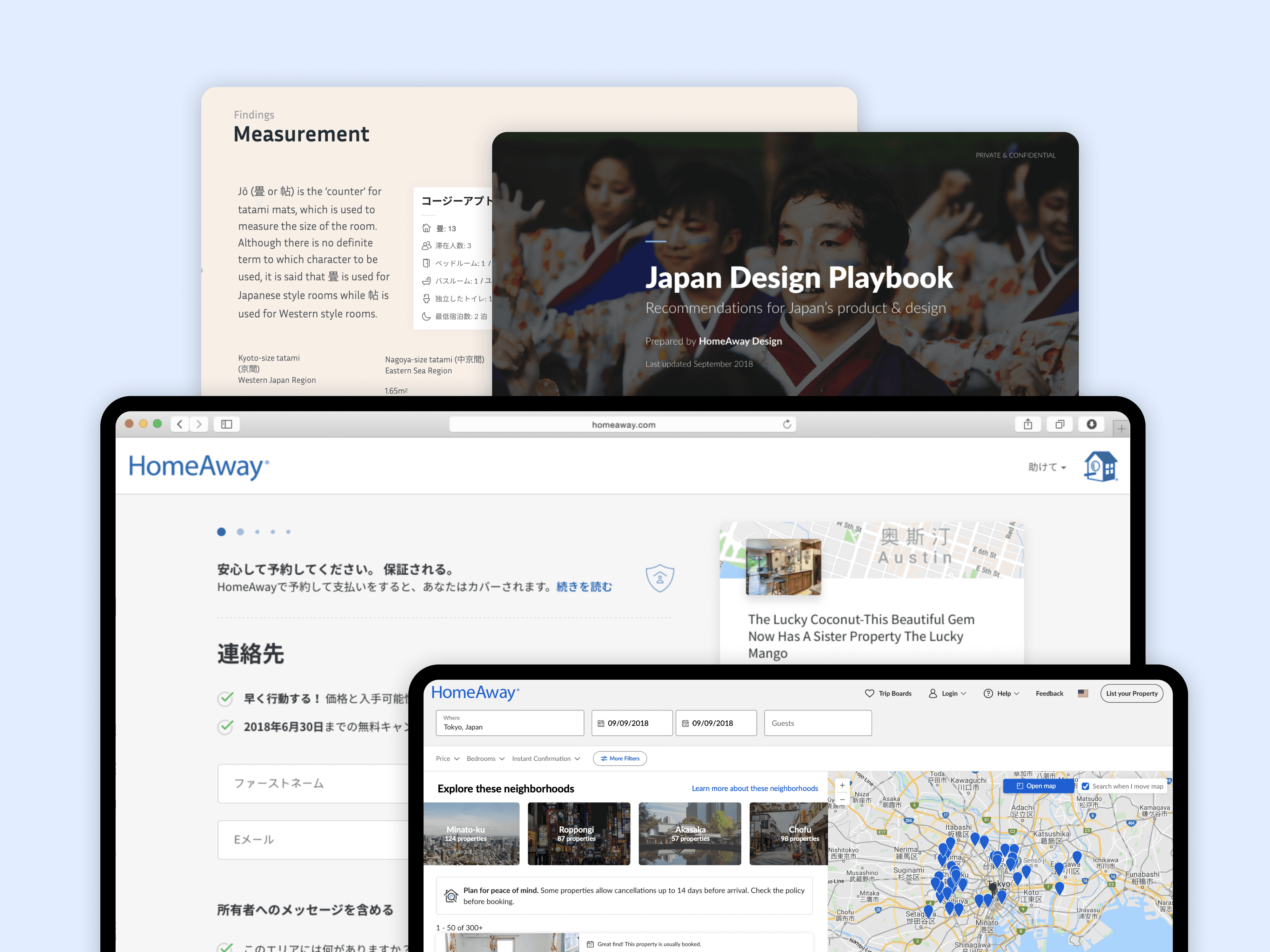
Armed with localized data, the team pivoted from a "global-first" approach to a highly nuanced regional design strategy, documenting these rules in the "Japan Design Playbook" which was presented in a Q3 2018 Quarterly Product Review.
Taxonomy and navigation: Unlike Western users who favor open search bars, Japanese users prefer structured, hierarchical "drill-down" map browsing. The interface was updated to prioritize prefecture-first browse trees and region-centric map filters.
Real estate configurations: Global descriptors were insufficient. The team implemented Japan-specific rooming configurations, distinguishing between Unit Baths (tub, sink, and toilet together) and Separated facilities. Room sizes were adjusted to measure in Tatami mat standard units (Jō), accounting for regional variations like Kyoto-size versus Kanto-size, and layouts were defined using the local LDK (Living, Dining, Kitchen) naming conventions.
Nuanced translation and typography: Direct translations were actively misleading users; for example, the term "Dorm" in Japan implies student housing rather than a guest house, and "Villa" or "Cabin" were entirely unfamiliar terms. The UI was also updated to support CJK (Chinese, Japanese, Korean) fonts like Noto Sans JP, solving severe layout breaks caused by the spacing differences between half-width and full-width Japanese characters.
Localized formatting: Forms were overhauled to match local mental models. Address inputs were restructured to ask for the Postal Code first, which would instantly auto-populate the Prefecture and Municipality fields. Additionally, the English calendar format was scrapped in favor of the Japanese standard, which utilizes numeric month indicators followed by Kanji.
Armed with localized data, the team pivoted from a "global-first" approach to a highly nuanced regional design strategy, documenting these rules in the "Japan Design Playbook" which was presented in a Q3 2018 Quarterly Product Review.
Taxonomy and navigation: Unlike Western users who favor open search bars, Japanese users prefer structured, hierarchical "drill-down" map browsing. The interface was updated to prioritize prefecture-first browse trees and region-centric map filters.
Real estate configurations: Global descriptors were insufficient. The team implemented Japan-specific rooming configurations, distinguishing between Unit Baths (tub, sink, and toilet together) and Separated facilities. Room sizes were adjusted to measure in Tatami mat standard units (Jō), accounting for regional variations like Kyoto-size versus Kanto-size, and layouts were defined using the local LDK (Living, Dining, Kitchen) naming conventions.
Nuanced translation and typography: Direct translations were actively misleading users; for example, the term "Dorm" in Japan implies student housing rather than a guest house, and "Villa" or "Cabin" were entirely unfamiliar terms. The UI was also updated to support CJK (Chinese, Japanese, Korean) fonts like Noto Sans JP, solving severe layout breaks caused by the spacing differences between half-width and full-width Japanese characters.
Localized formatting: Forms were overhauled to match local mental models. Address inputs were restructured to ask for the Postal Code first, which would instantly auto-populate the Prefecture and Municipality fields. Additionally, the English calendar format was scrapped in favor of the Japanese standard, which utilizes numeric month indicators followed by Kanji.
Impact
Impact
The deployment of the Japan Design Playbook established a scalable framework for cross-cultural localization. By integrating sticky tabs on detail pages, visible filtering on search results, and localized transparency around property managers, the redesign directly improved the Japanese checkout conversion rate by 12%. Furthermore, it accelerated cross-team engineering and design reviews, saving countless hours by providing a bulletproof, localization-friendly component library.
The deployment of the Japan Design Playbook established a scalable framework for cross-cultural localization. By integrating sticky tabs on detail pages, visible filtering on search results, and localized transparency around property managers, the redesign directly improved the Japanese checkout conversion rate by 12%. Furthermore, it accelerated cross-team engineering and design reviews, saving countless hours by providing a bulletproof, localization-friendly component library.